मराठी
कर्नाटक बोर्ड पी.यू.सी.पीयूसी विज्ञान 2nd PUC Class 12

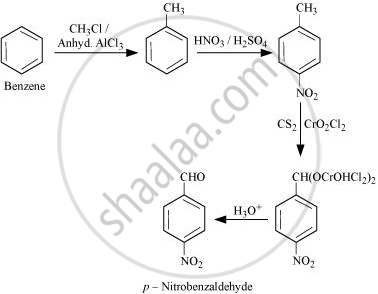
How will you prepare the given compound from benzene? You may use any inorganic reagent and any organic reagent having not more than one carbon atom. p-Nitrobenzaldehyde - Chemistry

Advertisements
Advertisements

प्रश्न

How will you prepare the given compound from benzene? You may use any inorganic reagent and any organic reagent having not more than one carbon atom.

p-Nitrobenzaldehyde

रासायनिक समीकरणे/रचना
Advertisements

उत्तर
shaalaa.com
  या प्रश्नात किंवा उत्तरात काही त्रुटी आहे का?
पाठ 8: Aldehydes, Ketones and Carboxylic Acids - Exercises [पृष्ठ २५६]

APPEARS IN

एनसीईआरटी Chemistry Part 1 and 2 [English] Class 12
पाठ 8 Aldehydes, Ketones and Carboxylic Acids
Exercises | Q 8.14 (v) | पृष्ठ २५६

संबंधित प्रश्‍न

How will you bring about the following conversion?

Benzoyl chloride to benzaldehyde.


Predict the product of the following reaction:


When 0.4 g of acetic acid is dissolved in 40 g of benzene, the freezing point of the solution is lowered by 0.45 K. Calculate the degree of association of acetic acid. Acetic acid forms dimer when dissolved in benzene.
(Kf for benzene = 5.12 K kg mol−1, at. wt. C = 12, H = 1, O = 16)


The oxidation of toluene to benzoic acid can be stopped at the aldehyde stage to give benzaldehyde. The reagent used for the purpose is one of the following.


Aldehydes are prepared by reducing nitriles to corresponding imines with stannous chloride in the presence of hydrochloric acid. This reaction is called:


The oxidation of toluene to benzoic acid can be done using which of the following reagents.


Name the electrophile produced in the reaction of benzene with benzoyl chloride in the presence of anhydrous \[\ce{AlCl3}\]. Name the reaction also.


Match the example given in Column I with the name of the reaction in Column II.

  Column I
(Example)
  Column II
(Reaction)
(i) \[\begin{array}{cc}
\phantom{...}\ce{O}\phantom{..............................}\ce{O}\phantom{}\\
\phantom{...}||\phantom{..............................}||\phantom{}\\
\ce{CH3 - C - Cl + H2 ->[Pd - C/BasO4] CH3 - C - H}
\end{array}\]
(a) Friedel Crafts acylation
(ii) (b) HVZ reaction
(iii) (c) Aldol condensation
(iv) \[\begin{array}{cc}
\ce{R - CH2 - COOH ->[Br/Red P] R - CH - COOH}\\
\phantom{.....................}|\\
\phantom{.......................}\ce{Br}
\end{array}\]
(d) Cannizaro’s reaction
(v) \[\ce{CH3 - CN ->[(i) SnCl2/HCl][(ii) H2O/H+] CH3CHO}\] (e) Rosenmund’s reductio
(vi) \[\ce{2CH3CHO ->[NaOH] CH3 - CH = CHCHO}\] (f) Stephen’s reaction

An aromatic compound ‘A’ (Molecular formula \[\ce{C8H8O}\]) gives positive 2, 4-DNP test. It gives a yellow precipitate of compound ‘B’ on treatment with iodine and sodium hydroxide solution. Compound ‘A’ does not give Tollen’s or Fehling’s test. On drastic oxidation with potassium permanganate it forms a carboxylic acid ‘C’ (Molecular formula \[\ce{C7H6O2}\]), which is also formed along with the yellow compound in the above reaction. Identify A, B and C and write all the reactions involved.


What is the name of the given reaction of preparation of aldehyde?

\[\ce{C3COCl ->[H2][Pd/BaSO4] CH3CHO + HCl}\]


\[\begin{array}{cc}
\ce{CH3 - CH2 - CH - CH3}\\
\phantom{.....}|\\
\phantom{......}\ce{Cl}
\end{array}\]  obtained by chlorination of n-butane, will be


The strongest base among the following


Aldehydes are the first oxidation products of ______.


Convert the following:

Benzoic acid to Benzaldehyde.


Explain the following reactions:

Stephan reaction


Predict the reagent for carrying out the following transformations:

Benzoyl chloride to Benzaldehyde


Reagent used to convert allyl alcohol to acrolein is ______.


Write the name of the reaction, structure and IUPAC name of the product formed when:

CH3CH2CN reacts with stannous chloride in the presence of hydrochloric acid, followed by hydrolysis.


Share
Notifications

Englishहिंदीमराठी


      Forgot password?
Use app×