Advertisements
Advertisements
Question
Atomic radius is expressed in the unit ______.
Options
nanometer
picometer
micrometer
millimeter
Advertisements
Solution
Atomic radius is expressed in the unit picometer.
Explanation:
Because atoms are extremely small, their atomic radii are measured using very small units of length. While nanometres (1 nm = 10−9m) are sometimes used, the picometre (1 pm = 10−12m) is the most standard and precise unit for expressing atomic size in chemistry.
APPEARS IN
RELATED QUESTIONS
Arrange the following as per the instruction given in the bracket:
Mg, Cl, Na, S, Si (decreasing order of atomic size).
Which is greater in size an atom or a cation?
Give reason for the following:
Argon atom is bigger than chlorine atom.
What happens to the atomic size of elements on moving from left to right in a period?
With reference to the variation of properties in the Periodic Table, which of the following is generally true?
Atomic size increases from left to right across a period.
Arrange the following as per the instruction given in the bracket:
Mg, Cl, Na, S, Si, (decreasing order of atomic size).
Arrange the following as per the instruction given in the bracket
Na, K, Li (Increasing atomic size)
The changes in the properties of elements on moving from left to right across a period of the Periodic Table. For the property, choose the correct answer.
The atomic size:
Right or wrong sentence.
Nanometer unit is used to measure atomic radius.
Write an explanation.
Atomic radius
Some elements and their atomic radii are given here. Arrange them in decreasing order of their atomic radii. Identify which of the above elements is the biggest atom and which is smallest?
| Element | K | Na | Rb | Cs | Li |
| Atomic radius (pm) | 231 | 186 | 244 | 262 | 151 |
The electronic configuration of metal A is 2, 8, 18, 1.
The metal A when exposed to air and moisture forms B a green layered compound. A with con. H2 SO4 forms C and D along with water. D is a gaseous compound. Find A, B, C, and D.
Carbon belongs to the second period and Group 14. Silicon belongs to the third period and Group 14. If the atomic number of carbon is 6, the atomic number of silicon is ______
Atomic number of a few elements are given below
10, 20, 7, 14
- Identify the elements
- Identify the Group number of these elements in the Periodic Table
- Identify the Periods of these elements in the Periodic Table
- What would be the electronic configuration for each of these elements?
- Determine the valency of these elements
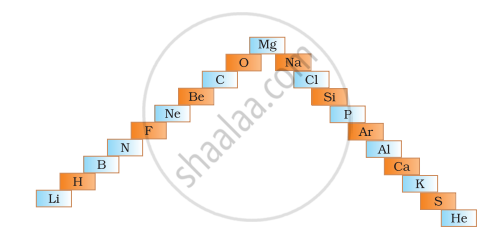
- In below ladder symbols of elements are jumbled up. Rearrange these symbols of elements in the increasing order of their atomic number in the Periodic Table.
- Arrange them in the order of their group also.
Arrange the following as per the instruction given in the bracket:
Carbon, Fluorine, Beryllium (decreasing order of atomic size).
Arrange the following in order of increasing radii:
Cl−, Cl
Explain your choice.
Arrange the following in order of increasing radii:
Mg2+, Mg, Mg+
Explain your choice.
