Advertisements
Advertisements
प्रश्न
Atomic radius is expressed in the unit ______.
पर्याय
nanometer
picometer
micrometer
millimeter
Advertisements
उत्तर
Atomic radius is expressed in the unit picometer.
Explanation:
Because atoms are extremely small, their atomic radii are measured using very small units of length. While nanometres (1 nm = 10−9m) are sometimes used, the picometre (1 pm = 10−12m) is the most standard and precise unit for expressing atomic size in chemistry.
APPEARS IN
संबंधित प्रश्न
Write the name and symbol of the element from the description.
The noble gas with the smallest atomic radius.
The following questions refer to the Periodic Table.
What happens to the atomic size of elements moving from top to bottom of a group?
On moving from left to right in a periodic table, the size of the atom ______.
The size of an atom is indicated by its ______.
Right or wrong sentence.
Nanometer unit is used to measure atomic radius.
Right or wrong sentence.
The size of an atom depends on the number of valence electrons.
Write information about the given atomic numbers in the table.
| Atomic Number | Electronic configuration | Group | Period | Element |
| 10 | ||||
| 20 | ||||
| 7 |
The electronic configuration of metal A is 2, 8, 18, 1.
The metal A when exposed to air and moisture forms B a green layered compound. A with con. H2 SO4 forms C and D along with water. D is a gaseous compound. Find A, B, C, and D.
An element X has mass number 40 and contains 21 neutrons in its atom. To which group of the Periodic Table does it belong?
When an atom of iodine becomes an iodine ion (I–) the radius will ______
Elements have been arranged in the following sequence on the basis of their increasing atomic masses.
| F, | Na, | Mg, | Al, | Si, | P, | S, | Cl, | Ar, | K |
- Pick two sets of elements which have similar properties.
- The given sequence represents which law of classification of elements?
Arrange the following elements in increasing order of their atomic radii.
- Li, Be, F, N
- Cl, At, Br I
Write the formula of the product formed when the element A (atomic number 19) combines with the element B (atomic number 17). Draw its electronic dot structure. What is the nature of the bond formed?
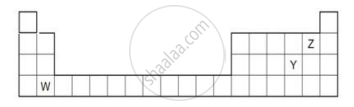
The diagram below shows part of the periodic table.
- Which elements would react together to form covalent compounds?
- Between the two elements W and Z, which will have a bigger atomic radius? Why?
Arrange the following in order of increasing radii:
Cl−, Cl
Explain your choice.
In Period 3 of the Periodic Table, element B is placed to the left of element A. On the basis of this information, choose the correct word from the option to complete the following statement:
The element A would have ______ atomic size than B.
This question refers to the elements of the Periodic Table with atomic numbers from 3 to 18. Some of the elements are shown by letters, but the letters are not the usual symbols of the elements.
| 3 | 4 | 5 | 6 | 7 | 8 | 9 | 10 |
| A | B | C | D | E | F | G | H |
| 11 | 12 | 13 | 14 | 15 | 16 | 17 | 18 |
| I | J | K | L | M | N | O | P |
Which of these have least atomic size in period 3?
