Advertisements
Advertisements
प्रश्न
The tendency of an element to form cation is the ______ character of that element.
पर्याय
non metallic
basic
metallic
acidic
Advertisements
उत्तर
The tendency of an element to form cation is the metallic character of that element.
Explanation:
Metallic character is defined by an element’s ability to lose electrons easily to form positive ions, known as cations. Metals are typically electropositive, meaning they have low ionisation enthalpy and readily donate electrons, whereas non-metals tend to gain electrons to form anions.
APPEARS IN
संबंधित प्रश्न
Arrange the following as per the instructions given in the brackets:
Na, K, Cl, S, Si (increasing order ionization energy)
In Period 3 of the Periodic Table, element B is placed to the left of element A. On the basis of this information, choose the correct word from the option to complete the following statement:
The element B would have ______ metallic character than A.
Name any five periods properties.
Give the trend in metallic character:
down the group top to bottom.
Explain the following:
Group 17 elements are strong non-metals, while group 1 elements are strong metals.
Complete the following sentences
Moving across a ………….. of the periodic table the elements show increasing ………………..character (group, period, metallic, non-metallic).
iii) Observe the figure and answer the following questions.
a) Identify the block shown by box A and write an electronic configuration of any one element of this block.
b) Identify the block of element denoted by letter B and write its period number.
In Period 3, the most metallic element is ______.
Study the extract of the Periodic Table given below and answer the questions that follow. Give the alphabet corresponding to the element in question. DO NOT repeat an element. 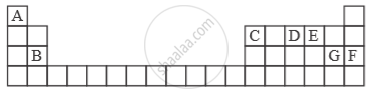
Which non-metallic element has the valency of 2?
Among the elements of the second period, Li to Ne, pick out the element that is the most reactive metal
For the main group of the periodic table, the metallic properties of the elements vary approximately with their position as shown in the table.
| 1 | 2 | 3 | 4 | 5 | 6 | 7 | 8 |
| H | He | ||||||
| A | B | ||||||
| C | D |
Will the most non-metallic element be found at A,B,C or D ?
A group of elements in the periodic table is given below (Boron is the first member of the group and thallium is the last.)
Boron
Aluminium
Gallium
Indium
Thallium
Answer the following questions in relation to the above group of elements:
- Which element has the most metallic character?
- Which element would be expected to have the highest electronegativity?
- If the electronic configuration of aluminium is 2, 8, 3, how many electrons will be there in the outermost shell of thallium?
- The atomic number of boron is 5. Write the chemical formula of the compound formed when boron reacts with chlorine.
- Will the elements in the group to the right of this boron group be more metallic or less metallic in character? Justify your answer.
Identify the metallic oxide which is amphoteric in nature.
Refering to changes in the properties of elements on moving from left to right across a period of the periodic table. Choose the correct answer.
The non-metallic character of the elements :
Use the information given in (a) to (h) to identify the substances P to W selecting your answers from the given list.
| List | ||
| Calcium | Oxygen | Copper (II) Oxide |
| Carbon | Calcium hydroxide | Copper (II) Nitrate |
| Lead (II) Oxide | Hydrogen chloride | Chlorine |
| Lead (II) Nitrate | Calcium Oxide | Ammonium chloride |
- P is white solid. When heated produces white fumes (sublime).
- P and R on warming produce an alkaline gas.
- On adding water to T, heat is evolved and R is formed.
- Q burns brightly in the air to form T.
- When S is heated, it gives off brown fumes and leaves a black residue of U.
- A solution of S is formed by warming U with dilute nitric acid.
- V is a gaseous non-metallic element that reacts with hydrogen to form W.
- A solution of W will neutralize the solution of R.
Arrange the following elements in order of their decreasing metallic character.
Na, Si, Cl, Mg, Al
The lightest liquid metal is ______
Which of the following sets of atomic numbers belong to that of alkali metals?
Identify the elements with the following property and arrange them in increasing order of their reactivity
- An element which is a soft and reactive metal
- The metal which is an important constituent of limestone
- The metal which exists in liquid state at room temperature
Choose the odd one out and write the reason:
