Advertisements
Advertisements
Question
Answer the following question.
Small Intestine is very long and coiled. Even if we jump and run, why it does not get twisted? What can happen if it gets twisted?
Advertisements
Solution
- Mesentery is a tissue that is located in the abdomen. It attaches the small intestine to the wall of the abdomen and keeps it in place and therefore it does not get twisted while running and jumping.
- If small intestine gets twisted, the affected spot may block the food, liquid passing through it. It may sometimes cut off the blood flow if the twist is very severe. If this happens the surrounding tissue may die and can cause serious problems.
APPEARS IN
RELATED QUESTIONS
Which part of the digestive canal is involved in:
Complete digestion of food ______.
List the enzymes and their action on food in the stomach and intestine.
Give Scientific reasons:
Consuming iodized salt in day to day diet is essential.
Write one function each of the following enzymes:
Pepsin
Fill in the blank.
The teeth called ______ are a total of four in number on the sides of incisors
Name the organ where the juice bile is temporarily stored.
Define the following term:
Digestion
Define the following term:
assimilation
Write true or false for the below statement. Rewrite the false statements correctly.
The wave-like motion of stomach muscles to push the food is called peristalsis.
Answer in detail.
You had eaten bread in the morning. Starting from the mouth, explain how it is digested?
Define with examples: Carnivores
State one difference in nutrition: Autotroph and Heterotroph
Describe protein digestion in the human.
Describe the process of digestion in human beings.
Who is telling a lie?
Liver: I am the largest gland in the body.
List out the functions of the digestive system.
Eating fast-food ad junk food affects our health. Justify.
Bile helps in the digestion of ______.
A calcified connective tissue from which the basic shape of the tooth is derived is known as ______.
Match the two columns and select correct option.
| Column - I | Column - II | ||
| i. | Sphincter of Oddi | a. | Oesophagus and stomach |
| ii. |
Ileo-caecal sphincter |
b. | Stomach and small intestine |
| iii. | Pyloric sphincter | c | Ileum and caecum |
| iv. |
Gastro-oesophageal sphincter |
d. | Opening of hepato- pancreatic duct |
A fluid containing the digestive enzyme ____________ is secreted by the serous cells of salivary gland.
Identify the option that indicates the correct enzyme that is secreted in location A, B and C.
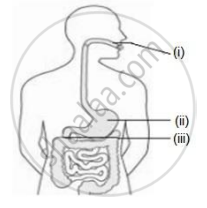
Name the organism which lives in the digestive system of human ______.
What are the functions of gastric glands present in the wall of the stomach?
Draw the diagram of the alimentary canal of man and label the following parts. Mouth, Oesophagus, Stomach, Intestine.
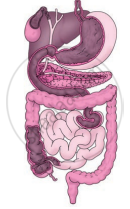
Label the following parts in Figure and name them.
- The largest gland in our body.
- The organ where protein digestion starts.
- The organ that releases digestive juice into the small intestine.
- The organ where bile juice gets stored.
Solve the crossword given as Figure.

| Across | Down | ||
| 1. | Cream-coloured digestive gland | 2. | Feeds with the help of pseudopodia |
| 3. | Undigested excretory solid residues | 6. | Total number of molars in one jaw of an adult |
| 4. | Organ that mixes saliva with the food | 8. | Largest gland |
| 5. | Point of defecation | 9. | Watery secretion in the mouth |
| 7. | Stored in gall bladder | 11. | A ruminant |
| 10. | Finger-like outgrowth in the small intestine | 12. | Form of food chewed by ruminants |
| 13. | Kind of taste buds | ||
| 14. | Kills bacteria in the stomach | ||
What is a vermiform appendix?
