Advertisements
Advertisements
प्रश्न
Answer the following question.
Small Intestine is very long and coiled. Even if we jump and run, why it does not get twisted? What can happen if it gets twisted?
Advertisements
उत्तर
- Mesentery is a tissue that is located in the abdomen. It attaches the small intestine to the wall of the abdomen and keeps it in place and therefore it does not get twisted while running and jumping.
- If small intestine gets twisted, the affected spot may block the food, liquid passing through it. It may sometimes cut off the blood flow if the twist is very severe. If this happens the surrounding tissue may die and can cause serious problems.
APPEARS IN
संबंधित प्रश्न
What is the role of saliva in the digestion of food?
The largest gland in the human body is ______.
Why do we get instant energy from glucose?
Which part of the digestive canal is involved in:
Killing of bacteria ______.
Name the main organs of the human digestive system.
The process of digestion in humans is completed in ______.
In human digestive system, bile is secreted by ______.
Pylorus is an opening from
Which one of the following pairs of types of teeth perform one common function as stated against it?
Why is there no enzyme to digest vitamins?
What is roughage? Give two examples.
Study the diagram given below and then answer the question that follows:
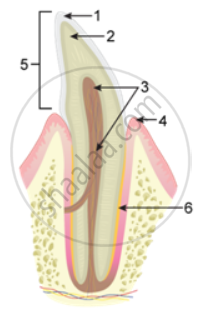
Name the parts labelled 1, 2, 3, 4, 5 and 6.
Last molar tooth in human beings is called ______.
Name the three enzymes found in pancreatic juice.
(i)____ (ii)____ (iii)_____
Define the following term:
assimilation
Answer in detail.
Name the four types of teeth and their functions
Answer in detail.
What changes occur in food in the mouth?
State one difference in nutrition: Parasite and Saprophyte
Correct the spellings: Reninne
Correct the spellings: Ptorein
The question has four options. Choose the correct answer:
The ileum is characterized by
The question has four options. Choose the correct answer:
Parotid salivary glands occur
The question has four options. Choose the correct answer:
The vermiform appendix is a constituent of
Appendix is a vestigial organ in humans and functional in herbivorous animals for the digestion of ____________.
The pyloric sphincter guards the passage between the ____________.
The exit of unabsorbed food material is regulated by ____________.
During deficiency of oxygen in tissues of human beings, pyruvic acid is converted into lactic acid in the
Name the correct substrates for the following enzymes
- Trypsin
- Amylase
- Pepsin
- Lipase
