Advertisements
Advertisements
प्रश्न
Answer the following question.
Small Intestine is very long and coiled. Even if we jump and run, why it does not get twisted? What can happen if it gets twisted?
Advertisements
उत्तर
- Mesentery is a tissue that is located in the abdomen. It attaches the small intestine to the wall of the abdomen and keeps it in place and therefore it does not get twisted while running and jumping.
- If small intestine gets twisted, the affected spot may block the food, liquid passing through it. It may sometimes cut off the blood flow if the twist is very severe. If this happens the surrounding tissue may die and can cause serious problems.
APPEARS IN
संबंधित प्रश्न
How is the small intestine designed to absorb digested food?
How are fats digested in our bodies? Where does this process take place?
What is meant by life processes?
Define a nutrient.
What is trypsin?
The process of digestion in humans is completed in ______.
| If the teeth are not cleaned regularly, they become covered with a sticky yellowish layer W of food particles and bacteria. Since layer W covers the teeth, the alkaline liquid X secreted by glands Y inside the mouth cannot reach the teeth surface to neutralise the acid formed by the action of organisms Z on sugary food, and hence tooth decay sets in. |
- What is W known as?
- What are (i) X and (ii) Y?
- What are organisms Z?
- State one way of removing layer W from the teeth.
Study the diagram given below and then answer the question that follows:
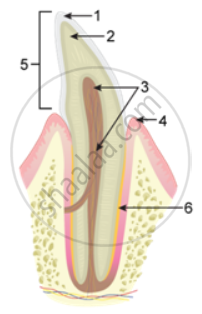
Describe the structure of the part labelled '3'.
Study the following dental formula and then answer the question that follow:
`"i" 3/4 "c" 0/0 "pm" 0/1 "m" 1/1`
Name an animal possessing such a dentition.
Study the Following Dental Formula and Then Answer the Question that Follow:
`"i" 3/4 "c" 0/0 "pm" 0/1 "m" 1/1`
Give the dental formula of an adult human being.
Answer the following question.
Write two different ways in which glucose is oxidized to provide energy in the human body. Write the products formed in each case.
Write the function of the following in the human alimentary canal:
Bile juice
Fill in the blank.
The teeth called ______ are a total of four in number on the sides of incisors
State whether the following statement is True or False.
The ducts from the salivary glands open into the duodenum.
What do you mean by the absorption of food?
Define the following term:
Egestion
Write true or false for the below statement. Rewrite the false statements correctly.
Digestion of food in the intestine takes place in the presence of dilute hydrochloric acid.
Write true or false for the below statement. Rewrite the false statements correctly.
Absorption of food takes place in small intestine
Write true or false for the below statement. Rewrite the false statements correctly.
All the absorbed nutrients are immediately required by the body.
Correct the spellings: Ptorein
Name the enzymes secreted by the following: Ileum
The question has four options. Choose the correct answer:
Parotid salivary glands occur
The question has four options. Choose the correct answer:
Stomach in vertebrates is the chief site of digestion of
Sketch and label a diagram of the digestive system and describe it in your own words.
A calcified connective tissue from which the basic shape of the tooth is derived is known as ______.
The process of digestion is completed by:
Observe the diagram of Human digestive system.
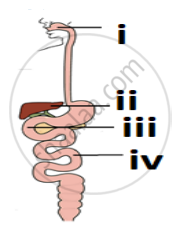
Match the labeling referred in column I and correlate with the function in column II.
| Column I | Column II | |
| i. | a. | The length of this depends on food the organism eats. |
| ii. | b. | Initial phase of starch digestion |
| iii. | c. | Increase the efficiency of lipase enzyme action |
| iv. | d. | This is the site of the complete digestion of carbohydrates, proteins and fats. |
Match the following:
| 1. | Pancreatic juice | a. | Breaking starch |
| 2. | Salivary enzymes | b. | Digestive enzymes |
| 3. | Salivary gland | c. | Alimentary canal |
| 4. | Digestive tract | d. | Parotid |
Solve the crossword given as Figure.

| Across | Down | ||
| 1. | Cream-coloured digestive gland | 2. | Feeds with the help of pseudopodia |
| 3. | Undigested excretory solid residues | 6. | Total number of molars in one jaw of an adult |
| 4. | Organ that mixes saliva with the food | 8. | Largest gland |
| 5. | Point of defecation | 9. | Watery secretion in the mouth |
| 7. | Stored in gall bladder | 11. | A ruminant |
| 10. | Finger-like outgrowth in the small intestine | 12. | Form of food chewed by ruminants |
| 13. | Kind of taste buds | ||
| 14. | Kills bacteria in the stomach | ||
What are the end products of digestion of starch, proteins, and fats respectively?
