Advertisements
Advertisements
Question
Name the types of teeth in human with functions.
Advertisements
Solution
There are four types of teeth:
- Incisors - These are used for cutting.
- Canines - These teeth are used for tearing.
- Premolars - For masticating the food.
- Molars - For grinding and masticating the food.
APPEARS IN
RELATED QUESTIONS
Name the enzyme present in human saliva. What type of food material is digested by this enzyme?
What will happen if mucus is not secreted by the gastric glands?
Study the diagram given below and then answer the question that follows:
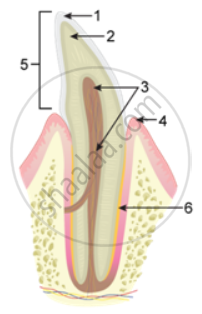
Describe the structure of the part labelled '3'.
State whether the following statement is True or False.
The ducts from the salivary glands open into the duodenum.
Name the three enzymes found in pancreatic juice.
(i)____ (ii)____ (iii)_____
Define the following term:
Egestion
Rewrite the following parts of the human alimentary canal in their correct sequence Stomach, Oesophagus, Large instestine, Small intestine, Pharynx.
State one difference in nutrition: Holophylic and Holozoic
Correct the spellings: Reninne
Name the enzymes secreted by the following: Pancreas
The question has four options. Choose the correct answer:
Monophyodont teeth occur in
Who is telling a lie?
Liver: I am the largest gland in the body.
How do the salivary glands come to know that there is food in the mouth and it is time to secrete saliva?
Throughout the length of the alimentary canal the layer which shows the presence of goblet cells is ______
Identify the correct human dental formula.
Cud is the name given to the food of ruminants which is ______.
Solve the crossword given as Figure.

| Across | Down | ||
| 1. | Cream-coloured digestive gland | 2. | Feeds with the help of pseudopodia |
| 3. | Undigested excretory solid residues | 6. | Total number of molars in one jaw of an adult |
| 4. | Organ that mixes saliva with the food | 8. | Largest gland |
| 5. | Point of defecation | 9. | Watery secretion in the mouth |
| 7. | Stored in gall bladder | 11. | A ruminant |
| 10. | Finger-like outgrowth in the small intestine | 12. | Form of food chewed by ruminants |
| 13. | Kind of taste buds | ||
| 14. | Kills bacteria in the stomach | ||
Curdling of milk protein is done by ______.
______ is the vestigeal organ in human.
Write the chemical name and Molecular formula of tooth enamel.
