Advertisements
Advertisements
Question
Cud is the name given to the food of ruminants which is ______.
Options
swallowed and undigested.
swallowed and partially digested.
properly chewed and partially digested.
properly chewed and completely digested.
Advertisements
Solution
Cud is the name given to the food of ruminants which is swallowed and partially digested.
Explanation:
The swallowed and partially digested food of the ruminants is called Cud.
APPEARS IN
RELATED QUESTIONS
Draw neat labelled diagram of the pancreas with their associated structures
What is the role of saliva in the digestion of food?
Name the enzyme present in human saliva. What type of food material is digested by this enzyme?
Which of the organs performs the function in humans?
Absorption of food
Pancreatic juice contains enzymes which digest ______.
Define the following term:
Assimilation
Study the diagram given below and then answer the question that follows:
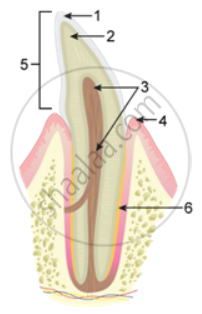
Describe the structure of the part labelled '3'.
Study the diagram given below and then answer the question that follows:
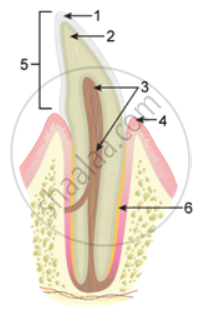
Give the total number of the type of tooth mentioned in '1' above, in the mouth of an adult and state its function.
Write True or False in the following statement
Molars help in cutting and tearing food.
Fill in the blanks in the table (1-5) by selecting the suitable names of substances from the list given below:
(steapsin, peptones, fatty acids, proteoses, protein).
| Digestive Enzymes | Acts on | To convert into |
| (i) Pepsin | _________(2) | ________(3) and |
| (ii) _______(1) | Fats |
________(4) _________(5) |
Name the juice secreted by the liver.
Name the types of teeth seen in humans.
Differentiate between
Digestion and Absorption
Describe the process of digestion in human beings.
The question has four options. Choose the correct answer:
The number of teeth that grow only once in human is
Circle the odd one.
A gland not associated with the alimentary canal is ____________.
What is digestion?
Draw the diagram of the alimentary canal of man and label the following parts. Mouth, Oesophagus, Stomach, Intestine.
What is chyme?
