Advertisements
Advertisements
Question
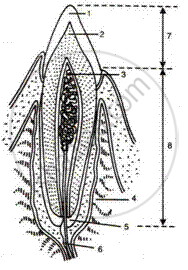
Observe the diagram given alongside and answer the following:
- Name the parts numbered 1-8.
- Which parts shown in the diagram are non-living?
- Is the tooth suited for cutting, tearing or grinding?
- What is the function of parts 8 and 7?
- What is the total number of teeth present in adult human beings?
- Write the dental formula of human beings.
Advertisements
Solution
- 1. Enamel; 2. Dentine; 3. Blood capillaries; 4. Cement; 5. Blood vessels; 6. Periodontal membrane; 7. crown and 8. root.
- Enamel, dentine and cement
- Yes
- The function of the root is to hold the teeth in the jaw and the function of the crown is it completely encircles and protects the teeth.
- 32
- The dental formula of humans is 12/2, C 1/1, P 2/2, M 3/3 (16x2= 32).
APPEARS IN
RELATED QUESTIONS
The largest gland in the human body is ______.
The tongue helps in mixing food with saliva.
What is the other name of food pipe?
What substance is mixed with food in the mouth during chewing by the teeth?
Which of the following has the longest small intestine?
Where are proteins first digested in the alimentary canal?
Write four sequential steps of the procedure of the experiment "Preparing a temporary mount of a leaf peel to show stomata".
Fill in the blanks.
The ______ and ______ are used for crushing and grinding the food.
State whether the following statement is True or False.
The temporary set of teeth includes incisors, canines, and premolars only.
Define the following term:
Egestion
Write true or false for the below statement. Rewrite the false statements correctly
Pancreatic juice does not contain any enzyme.
Define with examples: Carnivores
Define digestion.
Describe protein digestion in the human.
Correct the spellings: Ptorein
The question has four options. Choose the correct answer:
The vermiform appendix is a constituent of
What’s the solution?
A person has fainted, and a crowd of people has surrounded him.
The process of digestion is completed by:
Name the organism which lives in the digestive system of human ______.
