Advertisements
Advertisements
Question
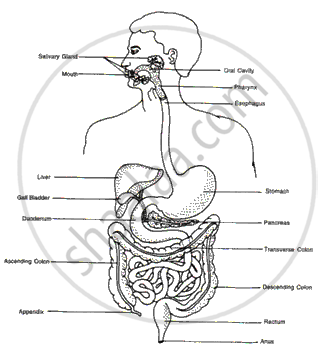
Describe the human alimentary canal.
Advertisements
Solution
Human alimentary canal consists of:
- Mouth - It is the first organ in the sequence which helps in sucking, chewing, salivation and swallowing. The food is ingested through mouth,
- Pharynx - It is situated behind the soft palate and leads into oesophagus. It is divided into three parts - nasopharynx, oropharyx and laryngopharynx.
- Oesophagus - It lies upto the middle of the thorax, behind the trachea and the heart. It pushes the food down into the stomach by peristaltic movements,
- Stomach - It is the widest organ ofthe alimentary canal. It is J - shaped and is divided into three parts: cardiac, body and pyloric.
- Intestine - It is of two types: small intestine and large intestine. Small intestine is the longest part of the alimentary canal and comprises of three regions - duodenum, jejunum and ileum. It helps in the absorption of food, Large intestine is divisible into three parts - caecum, colon and rectum. It absorbs water from the food.
APPEARS IN
RELATED QUESTIONS
What is the function of enzymes in the human digestive system?
| The partially digested food coming from the stomach of a person enters a long and narrow organ A in his body. The organ A receives the secretion of two glands : liver and pancreas. Liver secretes a greenish-yellow liquid B which is normally stored in the organ C. Pancreas secretes pancreatic juice which contains three digestive enzymes D, E and F. The intestinal juice completes the process of digestion of food. The inner wall of organ A has millions of tiny finger-like projections G which help in the rapid absorption of digested food into blood stream. The undigested part of food then passes into wider tube H which absorbs most of the water from undigested food. The last part of tube H called I stores this undigested food (or waste) for some time. The undigested food is then passed out though opening J as faeces in the process known as K. |
- Name the organ A.
- Name (i) liquid B, and (ii) organ C.
- What are the digestive enzymes D, E and F?
- Name the projections G present on the inner wall of organ A.
- Name (i) tube H (ii) part I (iii) opening J, and (iv) process K.
Pylorus is an opening from
Give any four reasons why water is necessary in our body.
Study the Following Dental Formula and Then Answer the Question that Follow:
`"i" 3/4 "c" 0/0 "pm" 0/1 "m" 1/1`
Give the dental formula of an adult human being.
Answer the following question.
Write two different ways in which glucose is oxidized to provide energy in the human body. Write the products formed in each case.
Write one function each of the following enzymes:
Lipase
Identify and name the four type of teeth shown below and give their functions

State whether the following statement is True or False.
The ducts from the salivary glands open into the duodenum.
State whether the following statement is True or False.
Saliva changes starch into maltose.
Fill in the blanks in the table (1-5) by selecting the suitable names of substances from the list given below:
(steapsin, peptones, fatty acids, proteoses, protein).
| Digestive Enzymes | Acts on | To convert into |
| (i) Pepsin | _________(2) | ________(3) and |
| (ii) _______(1) | Fats |
________(4) _________(5) |
Define the following term:
Egestion
Fill in the blanks.
Removal of undigested food is called ________.
Correct the spellings: Carboxytipepdase
Correct the spellings: Reninne
Breakdown of food into smaller molecules in our body is known as
Analogy
Enzymes: Digestive glands:: _______: Endocrine glands.
Identify the part of the digestive system which is vestigial in humans?
Digestion of food starts in ______ and gets completed in ______.
In which layer of the wall of alimentary canal, secretary glands are present?
