Advertisements
Advertisements
प्रश्न
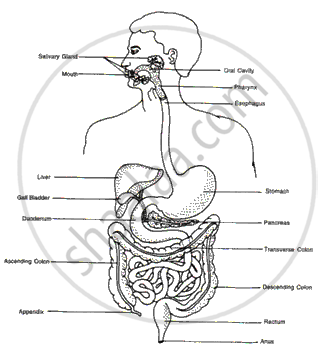
Describe the human alimentary canal.
Advertisements
उत्तर
Human alimentary canal consists of:
- Mouth - It is the first organ in the sequence which helps in sucking, chewing, salivation and swallowing. The food is ingested through mouth,
- Pharynx - It is situated behind the soft palate and leads into oesophagus. It is divided into three parts - nasopharynx, oropharyx and laryngopharynx.
- Oesophagus - It lies upto the middle of the thorax, behind the trachea and the heart. It pushes the food down into the stomach by peristaltic movements,
- Stomach - It is the widest organ ofthe alimentary canal. It is J - shaped and is divided into three parts: cardiac, body and pyloric.
- Intestine - It is of two types: small intestine and large intestine. Small intestine is the longest part of the alimentary canal and comprises of three regions - duodenum, jejunum and ileum. It helps in the absorption of food, Large intestine is divisible into three parts - caecum, colon and rectum. It absorbs water from the food.
APPEARS IN
संबंधित प्रश्न
The tongue helps in mixing food with saliva.
What is the location and function of the villi?
Which part of the digestive canal is involved in:
Chewing of food ______.
The process of digestion of food in humans begins in ______.
| When a person eats sugary food, then organisms A present in his mouth act on sugar to produce a substance B. The substance B first dissolves the calcium salts from the top part C of the tooth and then from its middle part D forming holes E. These holes ultimately reach the part F in the lower part of tooth which contains nerves and blood vessels. The substance B irritates the nerve endings inside the tooth causing toothache. |
- What are (i) organisms A, and (ii) substance B?
- What are (i) part C, and (ii) part D, of tooth known as?
- By what name are the holes E in the tooth known?
- Name the part F of the tooth.
- What will happen if organisms A reach part F of the tooth known?
How is thorough chewing of food helpful in digestion?
What are the main characteristics of enzyme?
Name the following
The organ where protein digestion-begins
Write true or false for the below statement. Rewrite the false statements correctly.
Absorption of food takes place in small intestine
Write short answers
What is ingestion?
Name the types of teeth in human with functions.
Who is telling a lie?
Large intestine: I am 7.5 meter long.
Appendix is a vestigial organ in humans and functional in herbivorous animals for the digestion of ____________.
Secretions of ____________ lubricate the lumen of the alimentary canal.
In which part of the alimentary canal food is finally digested?
The exit of unabsorbed food material is regulated by ____________.
What is the significance of the emulsification of fats?
Choose the correct order of terms that describes the process of nutrition in ruminants.
What are the end products of digestion of starch, proteins, and fats respectively?
