Advertisements
Advertisements
प्रश्न
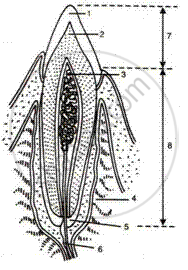
Observe the diagram given alongside and answer the following:
- Name the parts numbered 1-8.
- Which parts shown in the diagram are non-living?
- Is the tooth suited for cutting, tearing or grinding?
- What is the function of parts 8 and 7?
- What is the total number of teeth present in adult human beings?
- Write the dental formula of human beings.
Advertisements
उत्तर
- 1. Enamel; 2. Dentine; 3. Blood capillaries; 4. Cement; 5. Blood vessels; 6. Periodontal membrane; 7. crown and 8. root.
- Enamel, dentine and cement
- Yes
- The function of the root is to hold the teeth in the jaw and the function of the crown is it completely encircles and protects the teeth.
- 32
- The dental formula of humans is 12/2, C 1/1, P 2/2, M 3/3 (16x2= 32).
APPEARS IN
संबंधित प्रश्न
Pancreas, Gall bladder, Glomerulus, Liver
Where is the bile produced? Which component of the food does it help to digest?
In which part of the digestive system is water absorbed?
Where is digested food absorbed into blood in human body?
Which of the following component of our food is digested by an enzyme which is present in saliva as well as in pancreatic juice?
| When a person puts food in his mouth, then teeth cut it into small pieces, chew and grind it. The glands A in the mouth secrete a substance B which is mixed with the food by tongue. The substance B contains an enzyme C which starts the digestion of food in the mouth. The slightly digested food from the mouth goes down a tube D. The special type of movements E in the walls of tube D push the food into stomach for further digestion. The stomach wall secretes gastric juice containing three substance F, G and H. One of the functions of F is to kill bacteria which may enter the stomach with food. The substance G protects the inside layer of stomach from the damaging effect of substance F whereas substance H is and enzyme for digestion. The partially digested food then enters into small intestine for further digestion. |
- What are (i) gland A, (ii) substance B, and (iii) enzyme C?
- Name the tube D.
- What is the movement E known as?
- What are (i) F, (ii) G, and (iii) H?
Name the substance whose build up in the muscles during vigorous physical exercise may cause cramps.
Prepare a possible vegetarian menu for your dinner which would provide all the necessary nutrients.
Write the function of the following in the human alimentary canal:
Bile juice
Mention the different types of nutrition?
Describe the following: Emulsification
Mark odd one in the series:
The question has four options. Choose the correct answer:
The vermiform appendix is a constituent of
What is the length of the alimentary canal?
The other name of food pipe is alimentary canal.
Throughout the length of the alimentary canal the layer which shows the presence of goblet cells is ______
All are functions of the liver, EXCEPT
Liver transports nutrients, oxygen, wastes, and hormones.
What are the functions of gastric glands present in the wall of the stomach?
Cellulose-rich food substances are good source of roughage in human beings because ______.
