Advertisements
Advertisements
प्रश्न
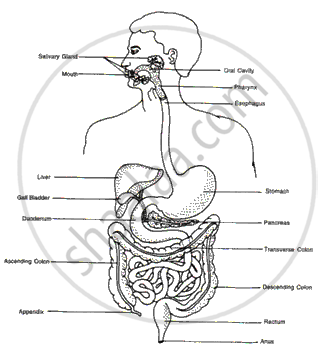
Describe the human alimentary canal.
Advertisements
उत्तर
Human alimentary canal consists of:
- Mouth - It is the first organ in the sequence which helps in sucking, chewing, salivation and swallowing. The food is ingested through mouth,
- Pharynx - It is situated behind the soft palate and leads into oesophagus. It is divided into three parts - nasopharynx, oropharyx and laryngopharynx.
- Oesophagus - It lies upto the middle of the thorax, behind the trachea and the heart. It pushes the food down into the stomach by peristaltic movements,
- Stomach - It is the widest organ ofthe alimentary canal. It is J - shaped and is divided into three parts: cardiac, body and pyloric.
- Intestine - It is of two types: small intestine and large intestine. Small intestine is the longest part of the alimentary canal and comprises of three regions - duodenum, jejunum and ileum. It helps in the absorption of food, Large intestine is divisible into three parts - caecum, colon and rectum. It absorbs water from the food.
APPEARS IN
संबंधित प्रश्न
The largest gland in the human body is ______.
Define holozoic nutrition.
If the saliva is lacking in salivary amylase, then which of the following processes taking place in the buccal cavity will be affected?
What is the function of rectum?
Why is the small intestine the most important organ of the digestive system?
Define the following term:
Assimilation
State whether the following statement is True or False.
The ducts from the salivary glands open into the duodenum.
Write true or false for the below statement. Rewrite the false statements correctly.
The pancreas secretes bile juice
Find the odd one out. Give reasons for your choice
Find the odd one out. Give reasons for your choice.
Answer in detail.
Name the four types of teeth and their functions
The question has four options. Choose the correct answer:
Teeth present in the upper molar of human beings are
Sketch and label a diagram of the digestive system and describe it in your own words.
A group of organs together make up an ______ system.
Name the organism which lives in the digestive system of human ______.
Why do we eat?
In which part of the alimentary canal food is finally digested?
Describe the alimentary canal of man.
What are villi?
