Advertisements
Advertisements
प्रश्न
The largest gland in the human body is ______.
Advertisements
उत्तर
The largest gland in the human body is liver.
APPEARS IN
संबंधित प्रश्न
Fill in the blank and rewrite the completed statement:
.................... is the largest gland in the body.
What is the location and function of the villi?
Which part of the digestive canal is involved in:
Absorption of food ______.
Which part of the body secretes bile?
Describe one way in which the small intestine is adapted for the absorption of digested food.
| The partially digested food coming from the stomach of a person enters a long and narrow organ A in his body. The organ A receives the secretion of two glands : liver and pancreas. Liver secretes a greenish-yellow liquid B which is normally stored in the organ C. Pancreas secretes pancreatic juice which contains three digestive enzymes D, E and F. The intestinal juice completes the process of digestion of food. The inner wall of organ A has millions of tiny finger-like projections G which help in the rapid absorption of digested food into blood stream. The undigested part of food then passes into wider tube H which absorbs most of the water from undigested food. The last part of tube H called I stores this undigested food (or waste) for some time. The undigested food is then passed out though opening J as faeces in the process known as K. |
- Name the organ A.
- Name (i) liquid B, and (ii) organ C.
- What are the digestive enzymes D, E and F?
- Name the projections G present on the inner wall of organ A.
- Name (i) tube H (ii) part I (iii) opening J, and (iv) process K.
Name the substance whose build up in the muscles during vigorous physical exercise may cause cramps.
List the enzymes and their action on food in the stomach and intestine.
Study the diagram given below and then answer the question that follows:
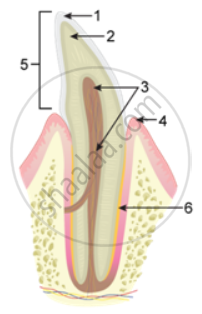
Describe the structure of the part labelled '3'.
Fill in the blank.
The human teeth appear in two sets, the first set is called primary which consists of only _______ teeth
Name the three regions of the large intestine.
Fill in the blank.
Saliva contains salivary amylase which changes starch to _____.
Give reasons for the following.
Meat eating animals have strong canines.
Answer in detail.
What changes occur in food in the mouth?
Define with examples: Herbivores
The question has four options. Choose the correct answer:
The vermiform appendix is a constituent of
Pushing forward the food that has been chewed is the function of the ______.
______ is a major organ for the digestion of food materials.
In which layer of the wall of alimentary canal, secretary glands are present?
