Advertisements
Advertisements
प्रश्न
Pushing forward the food that has been chewed is the function of the ______.
पर्याय
stomach
oesophagus
Advertisements
उत्तर
Pushing forward the food that has been chewed is the function of the oesophagus.
संबंधित प्रश्न
What is the role of the acid in our stomach?
Water from the undigested food is absorbed mainly in the ______.
What is the location and function of the villi?
Why do we get instant energy from glucose?
Which part of the digestive canal is involved in:
Formation of faeces ______.
What is meant by dental caries?
| When a person puts food in his mouth, then teeth cut it into small pieces, chew and grind it. The glands A in the mouth secrete a substance B which is mixed with the food by tongue. The substance B contains an enzyme C which starts the digestion of food in the mouth. The slightly digested food from the mouth goes down a tube D. The special type of movements E in the walls of tube D push the food into stomach for further digestion. The stomach wall secretes gastric juice containing three substance F, G and H. One of the functions of F is to kill bacteria which may enter the stomach with food. The substance G protects the inside layer of stomach from the damaging effect of substance F whereas substance H is and enzyme for digestion. The partially digested food then enters into small intestine for further digestion. |
- What are (i) gland A, (ii) substance B, and (iii) enzyme C?
- Name the tube D.
- What is the movement E known as?
- What are (i) F, (ii) G, and (iii) H?
Prepare a possible vegetarian menu for your dinner which would provide all the necessary nutrients.
What are the main characteristics of enzyme?
Define the following term:
Assimilation
State whether the following statement is True or False.
The ducts from the salivary glands open into the duodenum.
Fill in the blank.
Saliva contains salivary amylase which changes starch to _____.
Answer in detail.
What changes occur in food in the mouth?
State one difference in nutrition: Holozoic and Saprozoic nutrition
The question has four options. Choose the correct answer:
Teeth present in the upper molar of human beings are
Answer the following question.
Small Intestine is very long and coiled. Even if we jump and run, why it does not get twisted? What can happen if it gets twisted?
Write down the explanation.
Explain why human dentition is considered as thecodont, diphydont and heterodont.
Select the correct pair of peptide hormones secreted by the alimentary canal.
A few drops of iodine solution were added to rice water. The solution turned blue-black in colour. This indicates that rice water contains:
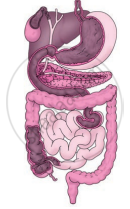
Label the following parts in Figure and name them.
- The largest gland in our body.
- The organ where protein digestion starts.
- The organ that releases digestive juice into the small intestine.
- The organ where bile juice gets stored.
