Advertisements
Advertisements
प्रश्न
Write down the explanation.
Explain why human dentition is considered as thecodont, diphydont and heterodont.
Advertisements
उत्तर
- Human dentition is described as thecodont, diphyodont and heterodont.
- It is called thecodont type because each tooth is fixed in a separate socket present in the jaw bones by gomphosis type of joint.
- It is called diphyodont type because we get only two sets of teeth, milk teeth and permanent teeth.
- It is called heterodont type because humans have four different type of teeth like incisors, canines, premolars and molars.
APPEARS IN
संबंधित प्रश्न
Draw neat labelled diagram of the pancreas with their associated structures
What is meant by life processes?
What is the function of enzymes in the human digestive system?
Name the substance on which the following enzymes act in the human digestive system:
Trypsin
Which of the following has the longest small intestine?
Where are proteins first digested in the alimentary canal?
Which of the following are the correct functions of two components of pancreatic juice trypsin and lipase?
Pylorus is an opening from
The water from the digested food is mainly absorbed by
Study the diagram given below and then answer the question that follows:
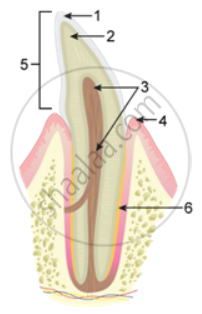
Describe the structure of the part labelled '3'.
Write one function each of the following enzymes:
Pepsin
Name the three regions of the large intestine.
Write true or false for the below statement. Rewrite the false statements correctly
Pancreatic juice does not contain any enzyme.
Differentiate between
Small intestine and Large intestine
Write short answers
What is ingestion?
Write short answers
What is peristalsis?
Mention the different types of nutrition?
Define with examples: Carnivores
State whether the following statements are True or false: Trypsin coagulates the milk protein.
Describe the following: Coagulation of milk in the digestive system.
The question has four options. Choose the correct answer:
The amount of saliva produced per day in human is
The question has four options. Choose the correct answer:
The vermiform appendix is a constituent of
The question has four options. Choose the correct answer:
Common passage for swallowing food and breathing is
The question has four options. Choose the correct answer:
The number of teeth that grow only once in human is
Write down the explanation.
Explain the structure of tooth.
A group of organs together make up an ______ system.
Bile helps in the digestion of ______.
A few drops of iodine solution were added to rice water. The solution turned blue-black in colour. This indicates that rice water contains:
Match the following:
| 1. | Pancreatic juice | a. | Breaking starch |
| 2. | Salivary enzymes | b. | Digestive enzymes |
| 3. | Salivary gland | c. | Alimentary canal |
| 4. | Digestive tract | d. | Parotid |
What are different types of cells present in the crypts of Lieberkuhn?
