Advertisements
Advertisements
प्रश्न
What is the location and function of the villi?
Advertisements
उत्तर १
- Villi expand the surface area of the intestine, facilitating the absorption of digested foods.
- Each villus contains a network of thin, tiny blood veins at its surface.
- The surface of the villus absorbs digested dietary molecules. Absorbed chemicals travel to various organs of the body via blood vessels.
उत्तर २
- The finger like projections in the inner walls of the small intestine is called villi. These are found in small intestine.
- Function: The villi increase the surface area for absorption of the digested food.
APPEARS IN
संबंधित प्रश्न
Name the enzyme present in human saliva. What type of food material is digested by this enzyme?
What will happen if mucus is not secreted by the gastric glands?
Why is the small intestine the most important organ of the digestive system?
Draw a labelled diagram to show the internal structure of a mammalian tooth with two roots.
Write four sequential steps of the procedure of the experiment "Preparing a temporary mount of a leaf peel to show stomata".
What is the main function of bile?
Fill in the blanks.
______ and ______ help in digestion but food does not pass through them.
Answer in detail.
What changes occur in food in the mouth?
Define with examples: Heterotrophs
Describe the following: Emulsification
Correct the spellings: HLC
The question has four options. Choose the correct answer:
Trypsin is connected with the digestion of
Give a reason.
Food becomes acidic in the stomach.
How do we know that we are hungry and that we should now eat?
How do the salivary glands come to know that there is food in the mouth and it is time to secrete saliva?
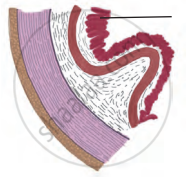
Observe the diagram. This is the histological structure of the stomach. Identify and comment on the significance of the layer marked by an arrow.
Identify the salivary gland lying below the tongue.
The exit of unabsorbed food material is regulated by ____________.
A gland not associated with the alimentary canal is ____________.
What is a vermiform appendix?
