Advertisements
Advertisements
प्रश्न
Advertisements
उत्तर
The pancreatic juice contains proenzymes trypsinogen, chymotrypsinogen, procarboxy peptidase, pancreatic amylase, and pancreatic lipase.
(a) Digestion of proteins by pancreatic juice: Trysinogen converts into trypsin in the presence of enterokinase. Trypsin converts chymotrypsinogen into chymotrypsin; procarboxypeptidase into carboxy-peptidase; and peptones into peptides. Trypsin, chymotrypsin, and carboxy-peptidase act upon proteins. Chymotrypsin also converts peptones into peptides. Peptides get converted into smaller peptides and amino acids in the presence of carboxypeptidase.
Trypsin ogen \[\ce{->[Enterokinase][of interstinal juice]}\] Trypsin
Chymotrypsin ogen \[\ce{->[Trypsin]}\] Chymotrypsin
Procarboxypep tidase \[\ce{->[Trypsin]}\] Carboxy - peptidase
Peptones \[\ce{->[Trypsin]}\] Peptides
Peptones \[\ce{->[Chymotrypsin]}\] Peptides
Peptides \[\ce{->[carboxypeptidase]}\] Smaller Peptides + Amino acid
(b) Digestion of carbohydrates by pancreatic juice: Pancreatic amylase acts upon starch in the presence of chlor ide ions and converts it into maltose, isomaltose and dextrin.
Starch \[\ce{->[Pancreatic][Amlylase + Cl-]}\] Maltose + Isomaltose + Limit dextrin.
(c) Digestion of fats: Pancreatic juice contains pancreatic lipase which emusifies the fats into fatty acids and glycerol.
Emulsified fat\[\ce{->[Pancreatic][lipase]}\] Fatty acid+ Glycerol
APPEARS IN
संबंधित प्रश्न
The largest gland in the human body is ______.
Which part of the digestive canal is involved in:
Complete digestion of food ______.
Which of the organs perform the following function in humans?
Absorption of water
Name the main organs of the human digestive system.
Name the substance whose build up in the muscles during vigorous physical exercise may cause cramps.
Gastric juice contains
Study the diagram given below and then answer the question that follows:

Identify the tooth and give a reason to support your answer.
How is the small intestine best suited for the digestion and absorption of food?
Write true or false for the below statement. Rewrite the false statements correctly.
All the absorbed nutrients are immediately required by the body.
Write short answers
What is ingestion?
Mention the different types of nutrition?
Describe the following: Digestion of fat in the intestine
Pushing forward the food that has been chewed is the function of the ______.
What bodily needs or sensations do you become aware of even though you are reading a book?
Name the organs of the digestive system
Eating fast-food ad junk food affects our health. Justify.
Match the two columns and select correct option.
| Column - I | Column - II | ||
| i. | Sphincter of Oddi | a. | Oesophagus and stomach |
| ii. |
Ileo-caecal sphincter |
b. | Stomach and small intestine |
| iii. | Pyloric sphincter | c | Ileum and caecum |
| iv. |
Gastro-oesophageal sphincter |
d. | Opening of hepato- pancreatic duct |
Identify the option that indicates the correct enzyme that is secreted in location A, B and C.
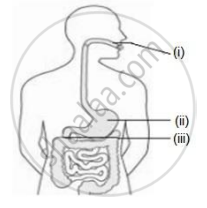
Read the following passage carefully and answer the questions that follow it.
| Bile juice is stored in a sac called, gall bladder, located near its organ of secretion, liver. The gall bladder releases the bile juice into the small intestine whenever food reaches there. Though bile juice is devoid of any digestive enzymes, it is required for the digestion of fats. The fats cannot be digested easily because they are insoluble in water and are present as large globules. Bile juice breaks down big fat droplets into smaller droplets. These are then easily digested by the enzymes released from the pancreas. |
- Which organ secretes the bile juice?
- Why is digestion of fats difficult as compared to that of other nutrients?
- How does bile juice help in the digestion of fat?
- Where is the digestion of fat completed?
- Does bile juice digest fat completely?
What is chyme?
