Advertisements
Advertisements
प्रश्न
Study the diagram given below and then answer the question that follows:

Identify the tooth and give a reason to support your answer.
Advertisements
उत्तर
The tooth shown in the diagram has only one root, so it is an incisor or canine which is used for biting and piercing.
APPEARS IN
संबंधित प्रश्न
The gall bladder temporarily stores bile.
Match the items of Column I with suitable items in Column II.
| Column I | Column II | ||
| (a) | Salivary gland | (i) | Bile juice secretion |
| (b) | Stomach | (ii) | Storage of undigested food |
| (c) | Liver | (iii) | Saliva secretion |
| (d) | Rectum | (iv) | Acid release |
| (e) | Small intestine | (v) | Digestion is completed |
| (f) | Large intestine | (vi) | Absorption of water |
| (vii) | Release of faeces |
Name any four life processes in living things.
What substance is mixed with food in the mouth during chewing by the teeth?
The length of small intestine in a human adult is about ______.
Where are proteins first digested in the alimentary canal?
Pylorus is an opening from
Prepare a possible vegetarian menu for your dinner which would provide all the necessary nutrients.
Fill in the blanks.
Incisors are used for _____ and _____ the food.
Write true or false for the below statement. Rewrite the false statements correctly
Pancreatic juice does not contain any enzyme.
Write true or false for the below statement. Rewrite the false statements correctly.
The removal of faeces through the anus is called excretion.
Describe the following: Emulsification
Mark odd one in the series:
Name the enzymes secreted by the following: Ileum
Who is telling a lie?
Tongue: My taste-buds can tell only a sweet taste.
Sketch and label a diagram of the digestive system and describe it in your own words.
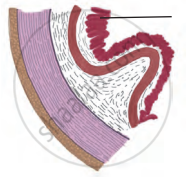
Observe the diagram. This is the histological structure of the stomach. Identify and comment on the significance of the layer marked by an arrow.
Identify the INCORRECT statement.
How do fats get digested in human beings?
Read the following passage carefully and answer the questions that follow it.
| Bile juice is stored in a sac called, gall bladder, located near its organ of secretion, liver. The gall bladder releases the bile juice into the small intestine whenever food reaches there. Though bile juice is devoid of any digestive enzymes, it is required for the digestion of fats. The fats cannot be digested easily because they are insoluble in water and are present as large globules. Bile juice breaks down big fat droplets into smaller droplets. These are then easily digested by the enzymes released from the pancreas. |
- Which organ secretes the bile juice?
- Why is digestion of fats difficult as compared to that of other nutrients?
- How does bile juice help in the digestion of fat?
- Where is the digestion of fat completed?
- Does bile juice digest fat completely?
