Advertisements
Advertisements
प्रश्न
What is digestion? Why do only animals require a digestive system?
Advertisements
उत्तर
Digestion is the process of breaking down complex food materials into simpler substances by the action of enzymes.
Need for a digestive system:
(i) Large complex molecules like carbohydrates, proteins and lipids need to be broken down to simpler molecules. These simpler molecules can then be absorbed and utilized by the body.
(ii) The breaking down of complex food molecules into their simpler form is possible only through the process of digestion.
(iii) During digestion, large complex macromolecules present in food are converted into small simpler molecules, which can be simplified in different compartments of digestive system only.
APPEARS IN
संबंधित प्रश्न
The tongue helps in mixing food with saliva.
Which of the organs performs the function in humans?
Absorption of food
Draw a labelled diagram of the human digestive system. With the help of this diagram, describe the process of digestion of food in man (humans).
Describe the parts of our tooth with the help of a labelled diagram.
| The partially digested food coming from the stomach of a person enters a long and narrow organ A in his body. The organ A receives the secretion of two glands : liver and pancreas. Liver secretes a greenish-yellow liquid B which is normally stored in the organ C. Pancreas secretes pancreatic juice which contains three digestive enzymes D, E and F. The intestinal juice completes the process of digestion of food. The inner wall of organ A has millions of tiny finger-like projections G which help in the rapid absorption of digested food into blood stream. The undigested part of food then passes into wider tube H which absorbs most of the water from undigested food. The last part of tube H called I stores this undigested food (or waste) for some time. The undigested food is then passed out though opening J as faeces in the process known as K. |
- Name the organ A.
- Name (i) liquid B, and (ii) organ C.
- What are the digestive enzymes D, E and F?
- Name the projections G present on the inner wall of organ A.
- Name (i) tube H (ii) part I (iii) opening J, and (iv) process K.
Pylorus is an opening from
Which one of the following pairs of types of teeth perform one common function as stated against it?
Study the diagram given below and then answer the question that follows:
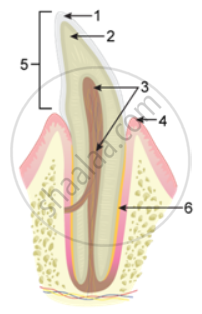
Give the total number of the type of tooth mentioned in '1' above, in the mouth of an adult and state its function.
Name the following
The organ into which the pancreatic juice and the bile juice are poured
State whether the following statement is True or False.
Wisdom tooth appears at the age of 5-6 years when the child starts going to school.
State the four ways in which saliva is useful to us.
Write true or false for the below statement. Rewrite the false statements correctly.
The process of taking in food is called assimilation
Give reasons for the following.
Meat eating animals have strong canines.
Define with examples: Heterotrophs
State one difference in nutrition: Holozoic and Saprozoic nutrition
Describe the following: Coagulation of milk in the digestive system.
The question has four options. Choose the correct answer:
The amount of saliva produced per day in human is
Use your brain power!
Why do we sometimes choke suddenly while eating?
The process of digestion is completed by:
Read the following passage carefully and answer the questions that follow it.
| Bile juice is stored in a sac called, gall bladder, located near its organ of secretion, liver. The gall bladder releases the bile juice into the small intestine whenever food reaches there. Though bile juice is devoid of any digestive enzymes, it is required for the digestion of fats. The fats cannot be digested easily because they are insoluble in water and are present as large globules. Bile juice breaks down big fat droplets into smaller droplets. These are then easily digested by the enzymes released from the pancreas. |
- Which organ secretes the bile juice?
- Why is digestion of fats difficult as compared to that of other nutrients?
- How does bile juice help in the digestion of fat?
- Where is the digestion of fat completed?
- Does bile juice digest fat completely?
