Advertisements
Advertisements
प्रश्न
The question has four options. Choose the correct answer:
The amount of saliva produced per day in human is
विकल्प
200 ml
500 ml
750-1000 ml
Liters
Advertisements
उत्तर
750-1000 ml
APPEARS IN
संबंधित प्रश्न
Write names of different parts of human digestive system and explain functions of any three parts.
Fat is completely digested in the ______.
| The partially digested food coming from the stomach of a person enters a long and narrow organ A in his body. The organ A receives the secretion of two glands : liver and pancreas. Liver secretes a greenish-yellow liquid B which is normally stored in the organ C. Pancreas secretes pancreatic juice which contains three digestive enzymes D, E and F. The intestinal juice completes the process of digestion of food. The inner wall of organ A has millions of tiny finger-like projections G which help in the rapid absorption of digested food into blood stream. The undigested part of food then passes into wider tube H which absorbs most of the water from undigested food. The last part of tube H called I stores this undigested food (or waste) for some time. The undigested food is then passed out though opening J as faeces in the process known as K. |
- Name the organ A.
- Name (i) liquid B, and (ii) organ C.
- What are the digestive enzymes D, E and F?
- Name the projections G present on the inner wall of organ A.
- Name (i) tube H (ii) part I (iii) opening J, and (iv) process K.
Explain the process of digestion of food in mouth, stomach and small intestine in human body.
Study the diagram given below and then answer the question that follows:
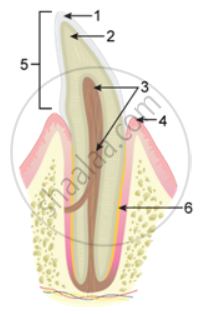
Name the parts labelled 1, 2, 3, 4, 5 and 6.
Study the diagram given below and then answer the question that follows:
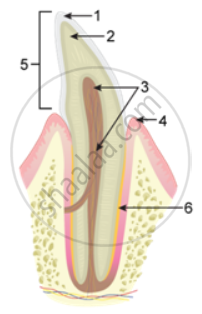
Describe the structure of the part labelled '3'.
Give two reasons to explain why the absorption of digested food occurs mainly in the small intestine.
Write one function each of the following enzymes:
Pepsin
Write one function each of the following enzymes:
Lipase
Name the organ where the juice bile is temporarily stored.
Name the digestive juice secreted by the stomach and give its function.
Fill in the blanks.
Removal of undigested food is called ________.
Complete the following enzymatic reaction.
Fats \[\ce{->[lipase]}\] ___________+__________
State one difference in nutrition: Autotroph and Heterotroph
Name the types of teeth in human with functions.
The question has four options. Choose the correct answer:
Trypsin is connected with the digestion of
A few drops of iodine solution were added to rice water. The solution turned blue-black in colour. This indicates that rice water contains:
What is the significance of the emulsification of fats?
Mark the following statement as True or False. If false, write the correct statement.
All heterotrophs have a similar basic process of nutrition.
Urea is a main excretory product in humans. How is it formed?
