Advertisements
Advertisements
प्रश्न
The question has four options. Choose the correct answer:
The amount of saliva produced per day in human is
पर्याय
200 ml
500 ml
750-1000 ml
Liters
Advertisements
उत्तर
750-1000 ml
APPEARS IN
संबंधित प्रश्न
What is the role of the acid in our stomach?
What is the other name of food pipe?
What substances are contained in gastric juice? What are their functions?
Name the substance whose build up in the muscles during vigorous physical exercise may cause cramps.
Where does digestion of fat take place in our body?
Consider the following two statements A and B and select the right option from (i)-(iv) about their correctness.
- Small intestine is shorter than large intestine.
- Small intestine is wider than large intestine.
Options :
(i)Both the statements are correct
(ii) Both the statements are wrong
(iii) Statement A is correct, B is wrong
(iv) Statement B is correct, A is wrong
Study the diagram given below and then answer the question that follows:
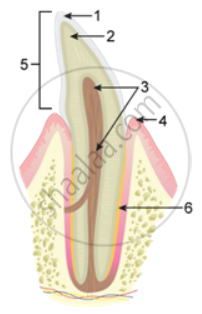
Describe the structure of the part labelled '3'.
Write the function of the following in the human alimentary canal:
Villi
Write True or False in the following statement
Molars help in cutting and tearing food.
Name the three enzymes found in pancreatic juice.
(i)____ (ii)____ (iii)_____
Fill in the blanks.
Grinding of food is brought about by _______ and ______
State one difference in nutrition: Holozoic and Saprozoic nutrition
The question has four options. Choose the correct answer:
Teeth present in the upper molar of human beings are
What makes respiration and blood circulation go on all the time, and the processes of digestion happen at the right time?
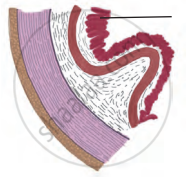
Observe the diagram. This is the histological structure of the stomach. Identify and comment on the significance of the layer marked by an arrow.
All are functions of the liver, EXCEPT
The pyloric sphincter guards the passage between the ____________.
______ is the common passage of air and food.
______ is a major organ for the digestion of food materials.
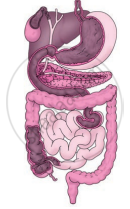
Label the following parts in Figure and name them.
- The largest gland in our body.
- The organ where protein digestion starts.
- The organ that releases digestive juice into the small intestine.
- The organ where bile juice gets stored.
