Advertisements
Advertisements
प्रश्न
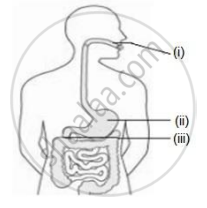
Write names of different parts of human digestive system and explain functions of any three parts.
Advertisements
उत्तर
(1) The digestive system of human beings consists of an alimentary canal and the associated digestive glands.

Alimentary canal: The human alimentary canal begins with the mouth and ends in the anus. It is a long muscular tube of varying diameter consisting of oesophagus, stomach, small intestine and large intestine. Associated digestive glands: The digestive glands associated with the alimentary canal are salivary glands and gastric glands.
(1) Mouth: In the mouth, there are teeth which masticate the food and convert the larger particles of food into smaller ones. The tongue helps in tasting the food and rolling it into a soft ball. There are salivary glands in the mouth which secrete saliva.
(2) Oesophagus: The oesophagus is a narrow tube carrying food to the stomach. Due to peristalsis, the food is pushed forward in the alimentary canal.
(3) Stomach: The stomach is a J-shaped muscular organ situated on the left side of the abdomen. Muscles of the stomach also undergo peristalsis and push the food forward. In the stomach, the food is mixed thoroughly with the gastric juice secreted by the gastric glands present in the stomach wall. There is a sphincter muscle at the lower end of the stomach. This sphincter muscle releases the partially digested food into the small intestine.
APPEARS IN
संबंधित प्रश्न
Draw neat labelled diagram of the pancreas with their associated structures
Which part of the digestive canal is involved in:
Killing of bacteria ______.
Which part of the digestive canal is involved in:
Complete digestion of food ______.
What substances are contained in pancreatic juice? What are their functions?
Define the terms 'nutrients'.
What is digestion? Why do only animals require a digestive system?
What is roughage? Give two examples.
Study the following dental formula and then answer the question that follow:
`"i" 3/4 "c" 0/0 "pm" 0/1 "m" 1/1`
State the total number of teeth present in the dentition.
Study the Following Dental Formula and Then Answer the Question that Follow:
`"i" 3/4 "c" 0/0 "pm" 0/1 "m" 1/1`
Give the dental formula of an adult human being.
What is the role of the liver and the pancreas respectively in the digestion of food?
Write true or false for the below statement. Rewrite the false statements correctly.
The pancreas secretes bile juice
Write true or false for the below statement. Rewrite the false statements correctly.
Saliva contains lipase which digests carbohydrates
Define homodont dentition.
Define with examples: Autotrophs
The question has four options. Choose the correct answer:
The vermiform appendix is a constituent of
A calcified connective tissue from which the basic shape of the tooth is derived is known as ______.
The process of digestion is completed by:
Identify the option that indicates the correct enzyme that is secreted in location A, B and C.
Describe the alimentary canal of man.
What are the end products of digestion of starch, proteins, and fats respectively?
