हिंदी

Draw neat labelled diagram of the pancreas with their associated structures

Advertisements
Advertisements

प्रश्न

Draw neat labelled diagram of the pancreas with their associated structures

Advertisements

उत्तर

Pancreas with its associated structures:

shaalaa.com
  क्या इस प्रश्न या उत्तर में कोई त्रुटि है?
2014-2015 (March)

APPEARS IN

संबंधित प्रश्न

What is the location and function of the villi?


What is the role of hydrochloric acid in our stomach?


What is trypsin?


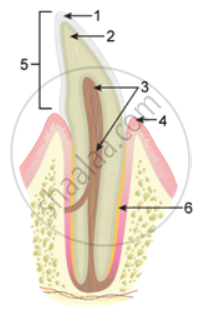
When a person eats sugary food, then organisms A present in his mouth act on sugar to produce a substance B. The substance B first dissolves the calcium salts from the top part C of the tooth and then from its middle part D forming holes E. These holes ultimately reach the part F in the lower part of tooth which contains nerves and blood vessels. The substance B irritates the nerve endings inside the tooth causing toothache.
  1. What are (i) organisms A, and (ii) substance B?
  2. What are (i) part C, and (ii) part D, of tooth known as?
  3. By what name are the holes E in the tooth known?
  4. Name the part F of the tooth.
  5. What will happen if organisms A reach part F of the tooth known?

When a person puts food in his mouth, then teeth cut it into small pieces, chew and grind it. The glands A in the mouth secrete a substance B which is mixed with the food by tongue. The substance B contains an enzyme C which starts the digestion of food in the mouth. The slightly digested food from the mouth goes down a tube D. The special type of movements E in the walls of tube D push the food into stomach for further digestion. The stomach wall secretes gastric juice containing three substance F, G and H. One of the functions of F is to kill bacteria which may enter the stomach with food. The substance G protects the inside layer of stomach from the damaging effect of substance F whereas substance H is and enzyme for digestion. The partially digested food then enters into small intestine for further digestion.
  1. What are (i) gland A, (ii) substance B, and (iii) enzyme C?
  2. Name the tube D.
  3. What is the movement E known as?
  4. What are (i) F, (ii) G, and (iii) H?

The partially digested food coming from the stomach of a person enters a long and narrow organ A in his body. The organ A receives the secretion of two glands : liver and pancreas. Liver secretes a greenish-yellow liquid B which is normally stored in the organ C. Pancreas secretes pancreatic juice which contains three digestive enzymes D, E and F. The intestinal juice completes the process of digestion of food. The inner wall of organ A has millions of tiny finger-like projections G which help in the rapid absorption of digested food into blood stream. The undigested part of food then passes into wider tube H which absorbs most of the water from undigested food. The last part of tube H called I stores this undigested food (or waste) for some time. The undigested food is then passed out though opening J as faeces in the process known as K.
  1. Name the organ A.
  2. Name (i) liquid B, and (ii) organ C.
  3. What are the digestive enzymes D, E and F?
  4. Name the projections G present on the inner wall of organ A.
  5. Name (i) tube H (ii) part I (iii) opening J, and (iv) process K.

List in tabular form two differences between pepsin and trypsin. 


Pylorus is an opening from


How is the liver an important organ in our body?


Name the following

The organ where protein digestion-begins


Write true or false for the below statement. Rewrite the false statements correctly.

The pancreas secretes bile juice


Write short answers

What is ingestion?


What makes respiration and blood circulation go on all the time, and the processes of digestion happen at the right time?


The other name of food pipe is alimentary canal.


The pyloric sphincter guards the passage between the ____________.


Secretions of ____________ lubricate the lumen of the alimentary canal.


Select the correct pair of peptide hormones secreted by the alimentary canal.


Solve the crossword given as Figure.

Across Down
1. Cream-coloured digestive gland 2. Feeds with the help of pseudopodia
3. Undigested excretory solid residues 6. Total number of molars in one jaw of an adult
4. Organ that mixes saliva with the food 8. Largest gland
5. Point of defecation 9. Watery secretion in the mouth
7. Stored in gall bladder 11. A ruminant
10. Finger-like outgrowth in the small intestine 12. Form of food chewed by ruminants
13. Kind of taste buds    
14. Kills bacteria in the stomach    

The complete digestion and absorption of nutrients is done by the small intestine. Which of the following greatly enhances the process of absorbtion?


In human beings, when the process of digestion is completed, the (i) proteins, (ii) carbohydrates and (iii) fats are respectively finally converted into ______.


Share
Notifications

Englishहिंदीमराठी


      Forgot password?
Use app×