Advertisements
Advertisements
प्रश्न
Study the following dental formula and then answer the question that follow:
`"i" 3/4 "c" 0/0 "pm" 0/1 "m" 1/1`
State the total number of teeth present in the dentition.
Advertisements
उत्तर
A total of 20 teeth are present in the given dentition.
APPEARS IN
संबंधित प्रश्न
How are fats digested in our bodies? Where does this process take place?
Which part of the digestive canal is involved in:
Formation of faeces ______.
Name any four life processes in living things.
Name the enzyme present in human saliva. What type of food material is digested by this enzyme?
What harm can dental plaque do?
Which part of alimentary canal receives bile from the liver?
How is the small intestine best suited for the digestion and absorption of food?
State one difference in nutrition: Autotroph and Heterotroph
Who is telling a lie?
Lung: I play an important role in excretion.
Name the organs of the digestive system
The other name of food pipe is alimentary canal.
The exit of unabsorbed food material is regulated by ____________.
Observe the diagram of Human digestive system.
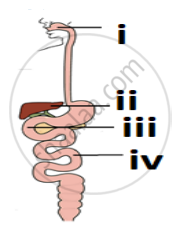
Match the labeling referred in column I and correlate with the function in column II.
| Column I | Column II | |
| i. | a. | The length of this depends on food the organism eats. |
| ii. | b. | Initial phase of starch digestion |
| iii. | c. | Increase the efficiency of lipase enzyme action |
| iv. | d. | This is the site of the complete digestion of carbohydrates, proteins and fats. |
What is digestion?
During deficiency of oxygen in tissues of human beings, pyruvic acid is converted into lactic acid in the
Describe the alimentary canal of man.
Choose the correct order of terms that describes the process of nutrition in ruminants.
Cellulose-rich food substances are good source of roughage in human beings because ______.
Name the parts of the alimentary canal where water gets absorbed from undigested food.
Solve the crossword given as Figure.

| Across | Down | ||
| 1. | Cream-coloured digestive gland | 2. | Feeds with the help of pseudopodia |
| 3. | Undigested excretory solid residues | 6. | Total number of molars in one jaw of an adult |
| 4. | Organ that mixes saliva with the food | 8. | Largest gland |
| 5. | Point of defecation | 9. | Watery secretion in the mouth |
| 7. | Stored in gall bladder | 11. | A ruminant |
| 10. | Finger-like outgrowth in the small intestine | 12. | Form of food chewed by ruminants |
| 13. | Kind of taste buds | ||
| 14. | Kills bacteria in the stomach | ||
