Advertisements
Advertisements
प्रश्न
Study the following dental formula and then answer the question that follow:
`"i" 3/4 "c" 0/0 "pm" 0/1 "m" 1/1`
State the total number of teeth present in the dentition.
Advertisements
उत्तर
A total of 20 teeth are present in the given dentition.
APPEARS IN
संबंधित प्रश्न
Describe one way in which the small intestine is adapted for the absorption of digested food.
With which human organ system (or human systems) is the villi associated?
Why is the small intestine the most important organ of the digestive system?
Name the following
The organ where protein digestion-begins
Given alongside is the diagram of the human alimentary canal.
(i) Name the parts 1-11 indicated by guidelines.
1.____ 2.____ 3.____ 4.____ 5.____ 6.____ 7.____ 8.____ 9.____ 10.___ 11.____
(ii) State the function of the juice secreted by the part 1.
(iii) State the function of the three enzymes found in the juice secreted by part 3.

Food are classified into three groups on the basis of the function they perform in our body. Name the three categories, and briefly give their functions. Also give their two sources each.
Write true or false for the below statement. Rewrite the false statements correctly.
Water is absorbed in large intestine
Define with examples: Omnivores
State whether the following statements are True or false: Enteropeptidase activates pepsinogen into pepsin.
The question has four options. Choose the correct answer:
Trypsin is connected with the digestion of
The question has four options. Choose the correct answer:
Teeth present in the upper molar of human beings are
The question has four options. Choose the correct answer:
The number of teeth that grow only once in human is
Who is telling a lie?
Liver: I am the largest gland in the body.
Who is telling a lie?
Large intestine: I am 7.5 meter long.
______ is the common passage of air and food.
Match the two columns and select correct option.
| Column - I | Column - II | ||
| i. | Sphincter of Oddi | a. | Oesophagus and stomach |
| ii. |
Ileo-caecal sphincter |
b. | Stomach and small intestine |
| iii. | Pyloric sphincter | c | Ileum and caecum |
| iv. |
Gastro-oesophageal sphincter |
d. | Opening of hepato- pancreatic duct |
Observe the diagram of Human digestive system.
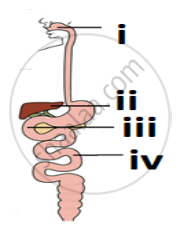
Match the labeling referred in column I and correlate with the function in column II.
| Column I | Column II | |
| i. | a. | The length of this depends on food the organism eats. |
| ii. | b. | Initial phase of starch digestion |
| iii. | c. | Increase the efficiency of lipase enzyme action |
| iv. | d. | This is the site of the complete digestion of carbohydrates, proteins and fats. |
Which part of the alimentary canal receives bile from the liver?
How does tooth enamel get corroded? What is the preventive measure for this?
