Advertisements
Advertisements
प्रश्न
Study the following dental formula and then answer the question that follow:
`"i" 3/4 "c" 0/0 "pm" 0/1 "m" 1/1`
Is the dentition that of a carnivore or herbivore? Give a reason to support your answer.
Advertisements
उत्तर
The given dentition is that of a herbivore because there are no canines present in the dentition. Canines are required by carnivores as they help in holding and tearing of food. The teeth of herbivores are used for cutting, gnawing, and biting, while the teeth of carnivores are sharper and more suited for catching, killing and tearing the prey.
APPEARS IN
संबंधित प्रश्न
The largest gland in the human body is ______.
Where does digestion of fat take place in our body?
What is digestion? Why do only animals require a digestive system?
Define the following term:
Kilocalorie
Complete the following table by filling in the blanks 1 to 8.
|
Organ |
Enzyme |
Food acted upon |
Find product |
|
1 |
Pepsin |
2 |
3 |
| Mouth | 4 | 5 | Disaccharide |
|
6 |
7 |
Maltose |
8 |
Write True or False in the following statement
Molars help in cutting and tearing food.
The teeth called canines are a total of four in number on the sides of ______.
Identify and name the four type of teeth shown below and give their functions

Write true or false for the below statement. Rewrite the false statements correctly.
Absorption of food takes place in small intestine
Define with examples: Carnivores
Correct the spellings: Carboxytipepdase
Describe the digestion of starch.
Which systems work together to provide the body with energy?
Eating fast-food ad junk food affects our health. Justify.
Identify which three of the following terminologies is true for human dentition.
In the given histology of the alimentary canal, identify i, ii, and iii.
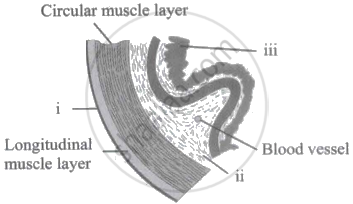
In which part of the alimentary canal food is finally digested?
Salivary glands secrete ______.
Liver produces for ______ the digestion of fat.
List the parts of the digestive system.
