Advertisements
Advertisements
प्रश्न
Study the following dental formula and then answer the question that follow:
`"i" 3/4 "c" 0/0 "pm" 0/1 "m" 1/1`
Name an animal possessing such a dentition.
Advertisements
उत्तर
The given dentition is likely to be present in any herbivore such as deer.
APPEARS IN
संबंधित प्रश्न
Digestion of starch starts in the stomach.
In which part of the digestive system is water absorbed?
In human digestive system, the enzymes pepsin and trypsin are secreted respectively by ______.
What are the main characteristics of enzyme?
How is the liver an important organ in our body?
List the enzymes and their action on food in the stomach and intestine.
Last molar tooth in human beings is called ______.
Fill in the blanks.
The ______ and ______ are used for crushing and grinding the food.
Define the following term:
Egestion
Fill in the blank.
Saliva contains salivary amylase which changes starch to _____.
Write true or false for the below statement. Rewrite the false statements correctly.
Water is absorbed in large intestine
Give reasons for the following.
Meat eating animals have strong canines.
Answer in detail.
You had eaten bread in the morning. Starting from the mouth, explain how it is digested?
The question has four options. Choose the correct answer:
The organ that stores bile is
The common bile duct and pancreatic form ______.
Secretions of ____________ lubricate the lumen of the alimentary canal.
Observe the diagram of Human digestive system.
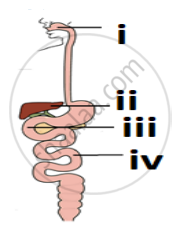
Match the labeling referred in column I and correlate with the function in column II.
| Column I | Column II | |
| i. | a. | The length of this depends on food the organism eats. |
| ii. | b. | Initial phase of starch digestion |
| iii. | c. | Increase the efficiency of lipase enzyme action |
| iv. | d. | This is the site of the complete digestion of carbohydrates, proteins and fats. |
______ is a major organ for the digestion of food materials.
Draw the diagram of the alimentary canal of man and label the following parts. Mouth, Oesophagus, Stomach, Intestine.
In human beings, when the process of digestion is completed, the (i) proteins, (ii) carbohydrates and (iii) fats are respectively finally converted into ______.
