Advertisements
Advertisements
प्रश्न
What is digestion? Why do only animals require a digestive system?
Advertisements
उत्तर
Digestion is the process of breaking down complex food materials into simpler substances by the action of enzymes.
Need for a digestive system:
(i) Large complex molecules like carbohydrates, proteins and lipids need to be broken down to simpler molecules. These simpler molecules can then be absorbed and utilized by the body.
(ii) The breaking down of complex food molecules into their simpler form is possible only through the process of digestion.
(iii) During digestion, large complex macromolecules present in food are converted into small simpler molecules, which can be simplified in different compartments of digestive system only.
APPEARS IN
संबंधित प्रश्न
The tongue helps in mixing food with saliva.
Which part of the digestive canal is involved in:
Chewing of food ______.
Which of the organs performs the function in humans?
Absorption of food
What is meant by life processes?
Fill in the blank.
Molars are meant for _____ the food.
Food are classified into three groups on the basis of the function they perform in our body. Name the three categories, and briefly give their functions. Also give their two sources each.
Complete the following enzymatic reaction.
Sucrose \[\ce{->[sucrase]}\] ___________+ __________
Name the enzymes secreted by the following: Salivary glands
What bodily needs or sensations do you become aware of even though you are reading a book?
Write down the explanation.
Explain the structure of tooth.
The process by which the body removes waste is called ______.
Circle the odd one.
Identify which three of the following terminologies is true for human dentition.
Observe the diagram of Human digestive system.
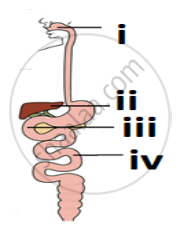
Match the labeling referred in column I and correlate with the function in column II.
| Column I | Column II | |
| i. | a. | The length of this depends on food the organism eats. |
| ii. | b. | Initial phase of starch digestion |
| iii. | c. | Increase the efficiency of lipase enzyme action |
| iv. | d. | This is the site of the complete digestion of carbohydrates, proteins and fats. |
List the glands associated with digestion.
How do fats get digested in human beings?
Mark the following statement as True or False. If false, write the correct statement.
All heterotrophs have a similar basic process of nutrition.
Fill in the blanks using the words listed below.
| water, front, intestinal, salts, pseudopodia, back, vacuole |
- The digestion of all food components is completed by the ______ juice.
- Large intestine absorbs ______ and some ______ from the undigested food.
- Tongue is attached at the ______ to the floor of the mouth cavity and is free at the ______.
- Amoeba pushes out ______ around the food and traps it in a food ______.
The complete digestion and absorption of nutrients is done by the small intestine. Which of the following greatly enhances the process of absorbtion?
