Advertisements
Advertisements
प्रश्न
State one difference in nutrition: Autotroph and Heterotroph
Advertisements
उत्तर
Autotroph is an organism which prepares organic food in their body from simple inorganic materials like carbon dioxide, water, etc. whereas heterotroph is an organism which cannot prepare its own food and depends on ready-made food synthesized by green plants.
APPEARS IN
संबंधित प्रश्न
Carbohydrates are bodybuilding nutrients.
Define the following term:
Kilocalorie
Study the diagram given below and then answer the question that follows:
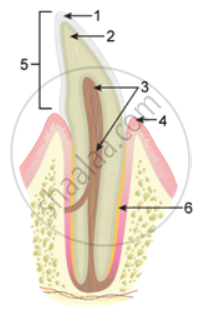
Give the total number of the type of tooth mentioned in '1' above, in the mouth of an adult and state its function.
Put a tick (✓) against the most appropriate alternative in the following statement.
The teeth which help in tearing the food are the:
Write True or False in the following statement
Molars help in cutting and tearing food.
What do you mean by the absorption of food?
Define the following term:
Digestion
State the four ways in which saliva is useful to us.
Food are classified into three groups on the basis of the function they perform in our body. Name the three categories, and briefly give their functions. Also give their two sources each.
Correct the spellings: Pespin
Describe the digestion of starch.
Describe the process of digestion in human beings.
Who is telling a lie?
Lung: I play an important role in excretion.
Identify the labels i, ii, iii, and iv in the given diagram of tooth anatomy.

A fluid containing the digestive enzyme ____________ is secreted by the serous cells of salivary gland.
The contraction and expansion movement of the walls of the food pipe is called ____________.
Given below from (i) to (iv) are some food items.
- Boiled and mashed potato
- Glucose solution
- A slice of bread
- Mustard oil
Which of the above will give a blue-black colour when tested with iodine?
What are the end products of digestion of starch, proteins, and fats respectively?
Rearrange the jumbled sequence of the different parts of the alimentary canal in proper sequence, (esophagus, small intestine, stomach, large intestine, anus, mouth, rectum)
