Advertisements
Advertisements
प्रश्न
Study the diagram given below and then answer the question that follows:
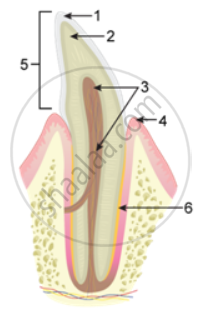
Name the parts labelled 1, 2, 3, 4, 5 and 6.
Advertisements
उत्तर
1 → Enamel
2 → Dentine
3 → Pulp
4 → Gum
5 → Crown
6 → Cement
APPEARS IN
संबंधित प्रश्न
What causes movement of food inside the alimentary canal?
What is the special name of the contraction and expansion movement which pushes the food further in our digestive tract (or alimentary canal)?
Where are proteins first digested in the alimentary canal?
The first enzyme to mix with food in the digestive tract is ______.
Gastric juice contains
Prepare a possible vegetarian menu for your dinner which would provide all the necessary nutrients.
Why is the small intestine the most important organ of the digestive system?
Define the term ‘digestion’.
Give reasons for the following:
All teeth in the mouth are not alike.
Answer in detail.
What is meant by digestion? How does it differ from nutrition?
Answer in detail.
Name the four types of teeth and their functions
Describe the process of digestion in human beings.
The question has four options. Choose the correct answer:
Monophyodont teeth occur in
The question has four options. Choose the correct answer:
The dental formula of human beings is
Name the salivary glands in our mouth?
Describe the alimentary canal of man
The coiled middle portion of the small intestine which is 2.5 meters long is the ______.
A few drops of iodine solution were added to rice water. The solution turned blue-black in colour. This indicates that rice water contains:
List the parts of the digestive system.
What are different types of cells present in the crypts of Lieberkuhn?
