Advertisements
Advertisements
प्रश्न
Answer in detail.
What is meant by digestion? How does it differ from nutrition?
Advertisements
उत्तर
The process of changing complex food into simple, absorbable form by the action of certain enzymes is called digestion. Many organs are associated with digestion. Digestion is of two types
1) Mechanical digestion
In mechanical digestion, food is broken down in the mouth when we chew it with our teeth.
2) Chemical digestion.
In chemical digestion, the food is digested by the actions of certain enzymes.
Digestion is necessary because the food which is obtained is in complex form and our body is not able to absorb nutrients from it. So it is converted into a simple absorbable form. Nutrition is the process of obtaining and using food by the organisms. It is different in different organisms. Ingestion, digestion, absorption, Assimilation, and egestion are the various steps involved in nutrition.
APPEARS IN
संबंधित प्रश्न
What is the role of the acid in our stomach?
Which one of the following pairs of types of teeth perform one common function as stated against it?
List two different functions performed by the pancreas in our body.
Define the following term:
Digestion
What is dental plaque?
Define with examples: Autotrophs
Describe the following: Digestion of fat in the intestine
The question has four options. Choose the correct answer:
The liver performs the function of
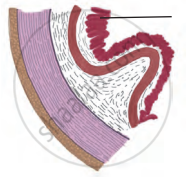
Observe the diagram. This is the histological structure of the stomach. Identify and comment on the significance of the layer marked by an arrow.
Solve the crossword given as Figure.

| Across | Down | ||
| 1. | Cream-coloured digestive gland | 2. | Feeds with the help of pseudopodia |
| 3. | Undigested excretory solid residues | 6. | Total number of molars in one jaw of an adult |
| 4. | Organ that mixes saliva with the food | 8. | Largest gland |
| 5. | Point of defecation | 9. | Watery secretion in the mouth |
| 7. | Stored in gall bladder | 11. | A ruminant |
| 10. | Finger-like outgrowth in the small intestine | 12. | Form of food chewed by ruminants |
| 13. | Kind of taste buds | ||
| 14. | Kills bacteria in the stomach | ||
