Advertisements
Advertisements
प्रश्न
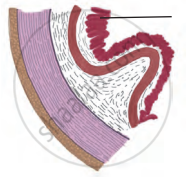
Observe the diagram. This is the histological structure of the stomach. Identify and comment on the significance of the layer marked by an arrow.
Advertisements
उत्तर
The layer marked in the diagram represents glandular epithelium of mucosa.
Significance of the glandular epithelium of mucosa:
Goblet cells of the epithelial layer of a mucous membrane secrete mucus which lubricates the lumen of the alimentary canal. This helps in movement of food through the gastrointestinal tract.
APPEARS IN
संबंधित प्रश्न
Water from the undigested food is absorbed mainly in the ______.
Which of the organs performs the function in humans?
Absorption of food
What substance is mixed with food in the mouth during chewing by the teeth?
Name the following:
An enzyme secreted by gastric glands in stomach which acts on proteins.
Describe the parts of our tooth with the help of a labelled diagram.
What harm can dental plaque do?
Pancreatic juice contains enzymes which digest ______.
Which of the following are the correct functions of two components of pancreatic juice trypsin and lipase?
Name the substance whose build up in the muscles during vigorous physical exercise may cause cramps.
Pylorus is an opening from
Why is there no enzyme to digest vitamins?
Give Scientific reasons:
Consuming iodized salt in day to day diet is essential.
Give two reasons to explain why the absorption of digested food occurs mainly in the small intestine.
Food are classified into three groups on the basis of the function they perform in our body. Name the three categories, and briefly give their functions. Also give their two sources each.
Write true or false for the below statement. Rewrite the false statements correctly.
The process of taking in food is called assimilation
Find the odd one out. Give reasons for your choice.
What do you mean by nutrition?
Define with examples: Omnivores
Describe the digestion of food in small intestine.
Describe the human salivary gland.
Correct the spellings: Ptorein
The question has four options. Choose the correct answer:
Stomach in vertebrates is the chief site of digestion of
Write any two functions of digestive system.
All are functions of the liver, EXCEPT
Liver produces for ______ the digestion of fat.
Describe the alimentary canal of man.
Given below from (i) to (iv) are some food items.
- Boiled and mashed potato
- Glucose solution
- A slice of bread
- Mustard oil
Which of the above will give a blue-black colour when tested with iodine?
Mark the following statement as True or False. If false, write the correct statement.
All heterotrophs have a similar basic process of nutrition.
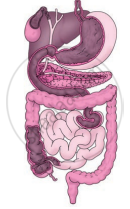
Label the following parts in Figure and name them.
- The largest gland in our body.
- The organ where protein digestion starts.
- The organ that releases digestive juice into the small intestine.
- The organ where bile juice gets stored.
What is chyme?
