Advertisements
Advertisements
Question
Study the diagram given below and then answer the question that follows:
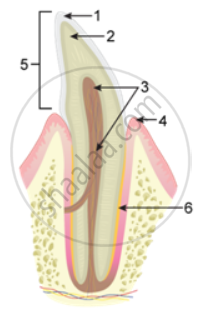
Name the parts labelled 1, 2, 3, 4, 5 and 6.
Advertisements
Solution
1 → Enamel
2 → Dentine
3 → Pulp
4 → Gum
5 → Crown
6 → Cement
APPEARS IN
RELATED QUESTIONS
What is the role of the acid in our stomach?
Where is the bile produced? Which component of the food does it help to digest?
What is the other name of food pipe?
Pancreatic juice contains enzymes which digest ______.
Pylorus is an opening from
Prepare a possible vegetarian menu for your dinner which would provide all the necessary nutrients.
Draw a diagram of the human alimentary canal and label - gall bladder, pancreas, liver, and small intestine on it.
Give two reasons to explain why the absorption of digested food occurs mainly in the small intestine.
Write the function of the following in the human alimentary canal:
HCl in stomach
State whether the following statement is True or False.
The temporary set of teeth includes incisors, canines, and premolars only.
Fill in the blank.
Steapsin is also called _________
Write true or false for the below statement. Rewrite the false statements correctly.
Saliva contains lipase which digests carbohydrates
What do you mean by nutrition?
State one difference in nutrition: Autotroph and Heterotroph
Mark odd one in the series:
The question has four options. Choose the correct answer:
The hardest constituent of the tooth is
Identify the salivary gland lying below the tongue.
Identify the labels i, ii, iii, and iv in the given diagram of tooth anatomy.

Name the organism which lives in the digestive system of human ______.
