Advertisements
Advertisements
Question
Mark odd one in the series:
Options
Oesophagus
Stomach
Intestine
Lungs
Advertisements
Solution
Lungs
APPEARS IN
RELATED QUESTIONS
Fill in the blank and rewrite the completed statement:
.................... is the largest gland in the body.
Draw neat labelled diagram of the pancreas with their associated structures
Match the items of Column I with suitable items in Column II.
| Column I | Column II | ||
| (a) | Salivary gland | (i) | Bile juice secretion |
| (b) | Stomach | (ii) | Storage of undigested food |
| (c) | Liver | (iii) | Saliva secretion |
| (d) | Rectum | (iv) | Acid release |
| (e) | Small intestine | (v) | Digestion is completed |
| (f) | Large intestine | (vi) | Absorption of water |
| (vii) | Release of faeces |
Which of the organs perform the following function in humans?
Absorption of water
What will happen if mucus is not secreted by the gastric glands?
Study the diagram given below and then answer the question that follows:
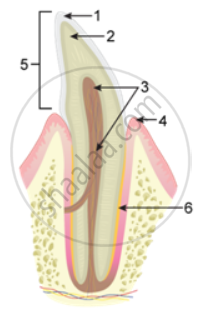
Name the parts labelled 1, 2, 3, 4, 5 and 6.
________ is the largest gland in the body.
What is the role of the liver and the pancreas respectively in the digestion of food?
Define the term ‘digestion’.
Write true or false for the below statement. Rewrite the false statements correctly
Pancreatic juice does not contain any enzyme.
Describe protein digestion in the human.
The question has four options. Choose the correct answer:
Stomach in vertebrates is the chief site of digestion of
Secretions of ____________ lubricate the lumen of the alimentary canal.
Select the correct pair of peptide hormones secreted by the alimentary canal.
What are the end products of digestion of starch, proteins, and fats respectively?
Rearrange the jumbled sequence of the different parts of the alimentary canal in proper sequence, (esophagus, small intestine, stomach, large intestine, anus, mouth, rectum)
In which layer of the wall of alimentary canal, secretary glands are present?
Write the chemical name and Molecular formula of tooth enamel.
