Advertisements
Advertisements
प्रश्न
Study the diagram given below and then answer the question that follows:
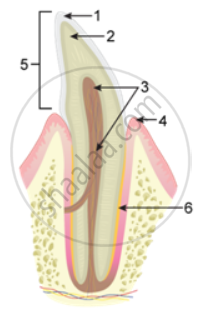
Name the parts labelled 1, 2, 3, 4, 5 and 6.
Advertisements
उत्तर
1 → Enamel
2 → Dentine
3 → Pulp
4 → Gum
5 → Crown
6 → Cement
APPEARS IN
संबंधित प्रश्न
Describe the parts of our tooth with the help of a labelled diagram.
Which of the following is the correct sequence of parts as they occur in the human alimentary canal?
Consider the following two statements A and B and select the right option from (i)-(iv) about their correctness.
- Small intestine is shorter than large intestine.
- Small intestine is wider than large intestine.
Options :
(i)Both the statements are correct
(ii) Both the statements are wrong
(iii) Statement A is correct, B is wrong
(iv) Statement B is correct, A is wrong
How is the liver an important organ in our body?
Define the following term :
Pylorus
Write the function of the following in the human alimentary canal:
Saliva
Write True or False in the following statement
Molars help in cutting and tearing food.
Fill in the blank.
The human teeth appear in two sets, the first set is called primary which consists of only _______ teeth
Name the following
The organ into which the pancreatic juice and the bile juice are poured
Write true or false for the below statement. Rewrite the false statements correctly.
The wave-like motion of stomach muscles to push the food is called peristalsis.
State one difference in nutrition: Holozoic and Saprozoic nutrition
State whether the following statements are True or false: Na+ is absorbed in intestine by sodium pump.
Describe the following: Digestion of fat in the intestine
The question has four options. Choose the correct answer:
The number of teeth that grow only once in human is
Use your brain power!
Why do we sometimes choke suddenly while eating?
Breakdown of food into smaller molecules in our body is known as
(i)______ and (ii)______ form the common bile duct.
What happens when we swallow our food?
During deficiency of oxygen in tissues of human beings, pyruvic acid is converted into lactic acid in the
Read the following passage carefully and answer the questions that follow it.
| Bile juice is stored in a sac called, gall bladder, located near its organ of secretion, liver. The gall bladder releases the bile juice into the small intestine whenever food reaches there. Though bile juice is devoid of any digestive enzymes, it is required for the digestion of fats. The fats cannot be digested easily because they are insoluble in water and are present as large globules. Bile juice breaks down big fat droplets into smaller droplets. These are then easily digested by the enzymes released from the pancreas. |
- Which organ secretes the bile juice?
- Why is digestion of fats difficult as compared to that of other nutrients?
- How does bile juice help in the digestion of fat?
- Where is the digestion of fat completed?
- Does bile juice digest fat completely?
