Advertisements
Advertisements
Question
Answer in detail.
What changes occur in food in the mouth?
Advertisements
Solution
The mouth is the first part of the digestive system. It receives food and starts mechanical digestion. The ingested food is first broken down in the mouth when it is chewed. Simultaneously it gets mixed with the saliva. This process is called mastication or mechanical digestion. It prepares the food for chemical digestion, that is, the digestion by action of enzyme. The teeth help in chewing down the food. There are 4 kinds of teeth. These are incisors, canines, premolars and molars, incisors are the cutting teeth. These help in biting and cutting the food. Canines are the tearing teeth that helps to tear and hold the food. Premolars and molars are the crushing and grinding teeth which help in grinding the food. When we chew the food it is mixed with saliva, secreted by salivary glands softens the food. Saliva contains an enzyme called salivary amylase also called ptyalin, acts on starch to convert it into maltose.
starch \[\ce{->[salivary][amylase]}\] maltose.
APPEARS IN
RELATED QUESTIONS
What is meant by life processes?
Draw a labelled diagram to show the internal structure of a mammalian tooth with two roots.
Study the diagram given below and then answer the question that follows:
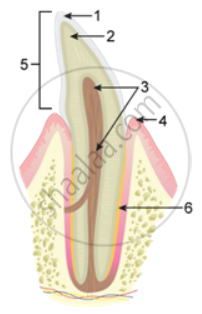
Describe the structure of the part labelled '3'.
Write the function of the following in the human alimentary canal:
Saliva
Write the function of the following in the human alimentary canal:
HCl in stomach
Write true or false for the below statement. Rewrite the false statements correctly.
Absorption of food takes place in small intestine
The question has four options. Choose the correct answer:
Monophyodont teeth occur in
Who is telling a lie?
Liver: I am the largest gland in the body.
What is the length of the alimentary canal?
List the parts of the digestive system.
