Advertisements
Advertisements
Question
Describe the human salivary gland.
Advertisements
Solution
Salivary Glands - Three pairs in man and secrete 1000 to 1500 cc saliva per day. Saliva is slightly acidic and its pH is 6.8.
There are three types of salivary glands:
- Parotid glands: It is the largest salivary gland and situated near the ears. It opens into oral cavity by Stenoson's duct.
- Sublingual glands: It is located beneath the tongue. It opens into the floor of oral cavity by duct of Rivinus.
- Submadibular or sub-maxillary glands: It is situated at the angles of the lower jaws. It opens inot oral cavity by Whartson's duct.
Each gland secret secretes saliva which is transported to the mouth cavity. At the time secrete saliva.
APPEARS IN
RELATED QUESTIONS
Name the biological catalysts which bring about chemical digestion of food.
Describe one way in which the small intestine is adapted for the absorption of digested food.
Pancreatic juice contains enzymes which digest ______.
List in tabular form two differences between pepsin and trypsin.
Draw a diagram of the human alimentary canal and label - gall bladder, pancreas, liver, and small intestine on it.
Fill in the blank.
Molars are meant for _____ the food.
Answer in detail.
What is meant by digestion? How does it differ from nutrition?
State one difference in nutrition: Autotroph and Heterotroph
Describe the human alimentary canal.
Describe the digestion of food in small intestine.
Describe protein digestion in the human.
Describe the following: Coagulation of milk in the digestive system.
Correct the spellings: Bilirubin
The question has four options. Choose the correct answer:
The dental formula of human beings is
Answer the following question.
Small Intestine is very long and coiled. Even if we jump and run, why it does not get twisted? What can happen if it gets twisted?
The common bile duct and pancreatic form ______.
______ is a major organ for the digestion of food materials.
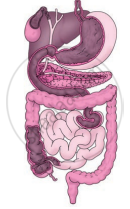
Label the following parts in Figure and name them.
- The largest gland in our body.
- The organ where protein digestion starts.
- The organ that releases digestive juice into the small intestine.
- The organ where bile juice gets stored.
What is a vermiform appendix?
Given below are two columns, Column I shows enzymes secreted by the glands in the alimentary canal of human beings and Column II indicates the components of food on which enzymes act. Choose the options showing correct matching:
