Advertisements
Advertisements
Question
Which one of the following pairs of types of teeth perform one common function as stated against it?
Options
Incisors, canines - Holding
Canines, premolars - Biting
Premolars, molars - Grinding
Molars, incisors - Tearing
Advertisements
Solution
Premolars, molars - Grinding
APPEARS IN
RELATED QUESTIONS
Where is the bile produced? Which component of the food does it help to digest?
Name the following:
An enzyme secreted by gastric glands in stomach which acts on proteins.
Consider the following two statements A and B and select the right option from (i)-(iv) about their correctness.
- Small intestine is shorter than large intestine.
- Small intestine is wider than large intestine.
Options :
(i)Both the statements are correct
(ii) Both the statements are wrong
(iii) Statement A is correct, B is wrong
(iv) Statement B is correct, A is wrong
Define the following term :
Omnivore
Study the diagram given below and then answer the question that follows:
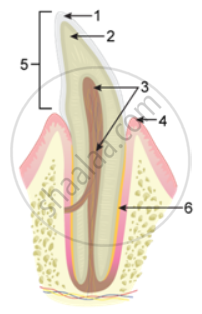
Give the total number of the type of tooth mentioned in '1' above, in the mouth of an adult and state its function.
Name the digestive juice secreted by the stomach and give its function.
Give reasons for the following.
Meat eating animals have strong canines.
State one difference in nutrition: Parasite and Saprophyte
Mark odd one in the series:
Name the enzymes secreted by the following: Stomach
The question has four options. Choose the correct answer:
Trypsin is connected with the digestion of
(i)______ and (ii)______ form the common bile duct.
All are functions of the liver, EXCEPT
Digestion of starch begins in the ______.
Mention the 3 important digestive glands in the process of digestion?
Explain the role of the mouth in digestion of food.
Read carefully the terms given below. Which of the following set is the correct combination of organs that do not carry out any digestive functions?
Mark the following statement as True or False. If false, write the correct statement.
All heterotrophs have a similar basic process of nutrition.
Rearrange the jumbled sequence of the different parts of the alimentary canal in proper sequence, (esophagus, small intestine, stomach, large intestine, anus, mouth, rectum)
Statement I - The muscularis of intestine can be differentiated into longitudinal and oblique muscles only.
Statement II - The muscularis of stomach is made up of outer- longitudinal, middle oblique and inner circular muscles.
In light of above statements, choose the most appropriate answer from the option given below.
