Advertisements
Advertisements
Question
Digestion of food starts in ______ and gets completed in ______.
Advertisements
Solution
Digestion of food starts in buccal cavity and gets completed in small intestine.
APPEARS IN
RELATED QUESTIONS
Fill in the blank and rewrite the completed statement:
.................... is the largest gland in the body.
How is the small intestine designed to absorb digested food?
Water from the undigested food is absorbed mainly in the ______.
Carbohydrates are bodybuilding nutrients.
Explain the process of digestion of food in mouth, stomach and small intestine in human body.
What is roughage? Give two examples.
Write one function each of the following enzymes:
Pepsin
Name the three enzymes found in pancreatic juice.
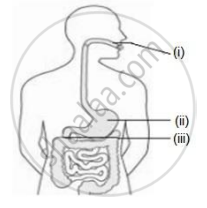
(i)____ (ii)____ (iii)_____
What is the role of the liver and the pancreas respectively in the digestion of food?
Define the following term:
Egestion
Write true or false for the below statement. Rewrite the false statements correctly.
All the absorbed nutrients are immediately required by the body.
Give reasons for the following.
Meat eating animals have strong canines.
Define with examples: Omnivores
State whether the following statements are True or false: Pancreatic amylase digests protein into amino acids.
Mark odd one in the series:
The question has four options. Choose the correct answer:
The organ that stores bile is
Write down the explanation.
Explain why human dentition is considered as thecodont, diphydont and heterodont.
Appendix is a vestigial organ in humans and functional in herbivorous animals for the digestion of ____________.
Identify the option that indicates the correct enzyme that is secreted in location A, B and C.
Urea is a main excretory product in humans. How is it formed?
