Advertisements
Advertisements
Question
What is roughage? Give two examples.
Advertisements
Solution
Roughage is a dietary fiber that largely consists of cellulose. It cannot be digested by our body as our body does not contain cellulose-digesting enzymes.
Examples of roughage:
- Fruits
- Green leafy vegetables
APPEARS IN
RELATED QUESTIONS
How is the small intestine designed to absorb digested food?
What is the role of saliva in the digestion of food?
What is the location and function of the villi?
Iodine turns blue-black on reacting with ______.
Which of the following has the longest small intestine?
Mention two ways in which the ileum of the mammal is adapted for the absorption of digested food.
The stomach secretes gastric juice, which contains hydrochloric acid. What is its function?
Complete the following table by filling in the blanks 1 to 8.
|
Organ |
Enzyme |
Food acted upon |
Find product |
|
1 |
Pepsin |
2 |
3 |
| Mouth | 4 | 5 | Disaccharide |
|
6 |
7 |
Maltose |
8 |
Fill in the blank.
Molars are meant for _____ the food.
Write true or false for the below statement. Rewrite the false statements correctly.
The removal of faeces through the anus is called excretion.
Define with examples: Heterotrophs
State one difference in nutrition: Holophylic and Holozoic
Name the types of teeth in human with functions.
Mark odd one in the series:
Why it is important to wear helmet while riding a bike?
Bile helps in the digestion of ______.
A fluid containing the digestive enzyme ____________ is secreted by the serous cells of salivary gland.
Observe the diagram of Human digestive system.
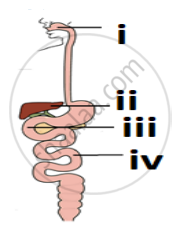
Match the labeling referred in column I and correlate with the function in column II.
| Column I | Column II | |
| i. | a. | The length of this depends on food the organism eats. |
| ii. | b. | Initial phase of starch digestion |
| iii. | c. | Increase the efficiency of lipase enzyme action |
| iv. | d. | This is the site of the complete digestion of carbohydrates, proteins and fats. |
Read the following passage carefully and answer the questions that follow it.
| Bile juice is stored in a sac called, gall bladder, located near its organ of secretion, liver. The gall bladder releases the bile juice into the small intestine whenever food reaches there. Though bile juice is devoid of any digestive enzymes, it is required for the digestion of fats. The fats cannot be digested easily because they are insoluble in water and are present as large globules. Bile juice breaks down big fat droplets into smaller droplets. These are then easily digested by the enzymes released from the pancreas. |
- Which organ secretes the bile juice?
- Why is digestion of fats difficult as compared to that of other nutrients?
- How does bile juice help in the digestion of fat?
- Where is the digestion of fat completed?
- Does bile juice digest fat completely?
Given below are two columns, Column I shows enzymes secreted by the glands in the alimentary canal of human beings and Column II indicates the components of food on which enzymes act. Choose the options showing correct matching:
