Advertisements
Advertisements
Question
Why is the small intestine the most important organ of the digestive system?
Advertisements
Solution
The small intestine is the most important organ of the digestive system as it serves both, for digestion and absorption. It receives two digestive juices; the bile and the pancreatic juice in the duodenum. These two juices virtually complete the digestion of starch, proteins, carbohydrates, etc. After the breakdown of food, the small intestine absorbs simple substances such as glucose, amino acids, etc.
APPEARS IN
RELATED QUESTIONS
How do carbohydrates get digested in human beings?
Which of the following component of our food is digested by an enzyme which is present in saliva as well as in pancreatic juice?
Pylorus is an opening from
Gastric juice contains
Which one of the following pairs of types of teeth perform one common function as stated against it?
Define the following term :
Omnivore
Study the following dental formula and then answer the question that follow:
`"i" 3/4 "c" 0/0 "pm" 0/1 "m" 1/1`
State the total number of teeth present in the dentition.
Study the following dental formula and then answer the question that follow:
`"i" 3/4 "c" 0/0 "pm" 0/1 "m" 1/1`
Name an animal possessing such a dentition.
Identify and name the four type of teeth shown below and give their functions

Fill in the blank.
Peristalsis is caused by _____________________________.
Find the odd one out. Give reasons for your choice.
Sketch and label a diagram of the digestive system and describe it in your own words.
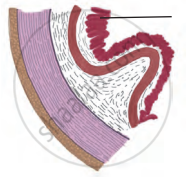
Observe the diagram. This is the histological structure of the stomach. Identify and comment on the significance of the layer marked by an arrow.
A few drops of iodine solution were added to rice water. The solution turned blue-black in colour. This indicates that rice water contains:
What are the compounds present in the food?
Name the correct substrates for the following enzymes
- Trypsin
- Amylase
- Pepsin
- Lipase
Given below from (i) to (iv) are some food items.
- Boiled and mashed potato
- Glucose solution
- A slice of bread
- Mustard oil
Which of the above will give a blue-black colour when tested with iodine?
The enzymes present in the saliva convert ______.
Digestion of food starts in ______ and gets completed in ______.
Rearrange the jumbled sequence of the different parts of the alimentary canal in proper sequence, (esophagus, small intestine, stomach, large intestine, anus, mouth, rectum)
