Advertisements
Advertisements
Question
What are the main characteristics of enzyme?
Advertisements
Solution
The enzyme is a protein. The main material of an enzyme is protein
- It is easily influenced, by environmental change. Environmental factors include temperature, pH, and inhibitor.
- It acts as catalyst The enzyme functions in accelerating chemical reaction, but the enzyme itself does not change after the reaction ends.
- It functions specifically. The enzyme only catalyzes one kind of substrate and cannot function for many substrates. The term is called one enzyme one substrate.
- It functions in reverse. It means the enzyme does not determine the direction of reaction, but it only functions in accelerating reaction rate until it reaches equilibrium. The enzyme also functions in substance synthesis and substance breaking down reaction.
- It is required, in small amount. A small amount of enzyme is able to catalyze a chemical reaction.
APPEARS IN
RELATED QUESTIONS
The largest gland in the human body is ______.
The stomach releases hydrochloric acid and ______ juices which act on food.
Which part of the digestive canal is involved in:
Chewing of food ______.
Label the following figure of the digestive system.

A part of the human digestive system
Name the biological catalysts which bring about chemical digestion of food.
The water from the digested food is mainly absorbed by
What is the dental formula of a normal human adult?
Draw a diagram of the human alimentary canal and label - gall bladder, pancreas, liver, and small intestine on it.
Write the function of the following in the human alimentary canal:
Saliva
How is the small intestine best suited for the digestion and absorption of food?
Write true or false for the below statement. Rewrite the false statements correctly.
The pancreas secretes bile juice
Write true or false for the below statement. Rewrite the false statements correctly.
Water is absorbed in large intestine
Write short answers
What do you mean by the emulsification of fat?
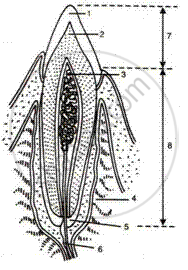
Observe the diagram given alongside and answer the following:
- Name the parts numbered 1-8.
- Which parts shown in the diagram are non-living?
- Is the tooth suited for cutting, tearing or grinding?
- What is the function of parts 8 and 7?
- What is the total number of teeth present in adult human beings?
- Write the dental formula of human beings.
State whether the following statements are True or false: Enteropeptidase activates pepsinogen into pepsin.
Correct the spellings: Disegion
Who is telling a lie?
Liver: I am the largest gland in the body.
Identify the INCORRECT statement.
Cellulose-rich food substances are good source of roughage in human beings because ______.
What are villi?
