Advertisements
Advertisements
Question
The question has four options. Choose the correct answer:
Parotid salivary glands occur
Options
below ears
below tongue
at the angle of jaws
below orbits
Advertisements
Solution
below ears
APPEARS IN
RELATED QUESTIONS
Fill in the blank and rewrite the completed statement:
.................... is the largest gland in the body.
Where is the bile produced? Which component of the food does it help to digest?
Which part of the digestive canal is involved in:
Chewing of food ______.
What is the special name of the contraction and expansion movement which pushes the food further in our digestive tract (or alimentary canal)?
Which of the following has the longest small intestine?
How is thorough chewing of food helpful in digestion?
Answer the following question.
Write two different ways in which glucose is oxidized to provide energy in the human body. Write the products formed in each case.
Write the function of the following in the human alimentary canal:
Saliva
Write four sequential steps of the procedure of the experiment "Preparing a temporary mount of a leaf peel to show stomata".
How is the small intestine best suited for the digestion and absorption of food?
Write true or false for the below statement. Rewrite the false statements correctly.
The removal of faeces through the anus is called excretion.
Define with examples: Herbivores
Name different steps involved in animal nutrition. Explain.
State whether the following statements are True or false: Pancreatic amylase digests protein into amino acids.
The question has four options. Choose the correct answer:
The vermiform appendix is a constituent of
Who is telling a lie?
Liver: I am the largest gland in the body.
Bile helps in the digestion of ______.
The coiled middle portion of the small intestine which is 2.5 meters long is the ______.
Observe the diagram of Human digestive system.
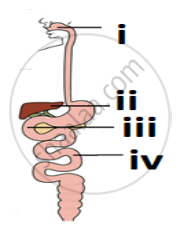
Match the labeling referred in column I and correlate with the function in column II.
| Column I | Column II | |
| i. | a. | The length of this depends on food the organism eats. |
| ii. | b. | Initial phase of starch digestion |
| iii. | c. | Increase the efficiency of lipase enzyme action |
| iv. | d. | This is the site of the complete digestion of carbohydrates, proteins and fats. |
