हिंदी

The Question Has Four Options. Choose the Correct Answer: Parotid Salivary Glands Occur

Advertisements
Advertisements

प्रश्न

The question has four options. Choose the correct answer:

Parotid salivary glands occur

विकल्प

  • below ears

  • below tongue

  • at the angle of jaws

  • below orbits

MCQ
Advertisements

उत्तर

below ears

shaalaa.com
  क्या इस प्रश्न या उत्तर में कोई त्रुटि है?
अध्याय 11: Digestive System (Teeth, Organs, Digestive Glands and their Functions).. - Exercise [पृष्ठ १५१]

APPEARS IN

फ्रैंक Biology Part 1 [English] Class 9 ICSE
अध्याय 11 Digestive System (Teeth, Organs, Digestive Glands and their Functions)..
Exercise | Q 20.07 | पृष्ठ १५१

वीडियो ट्यूटोरियलVIEW ALL [2]

संबंधित प्रश्न

What harm can dental plaque do?


Pancreatic juice contains enzymes which digest ______.


When a person eats sugary food, then organisms A present in his mouth act on sugar to produce a substance B. The substance B first dissolves the calcium salts from the top part C of the tooth and then from its middle part D forming holes E. These holes ultimately reach the part F in the lower part of tooth which contains nerves and blood vessels. The substance B irritates the nerve endings inside the tooth causing toothache.
  1. What are (i) organisms A, and (ii) substance B?
  2. What are (i) part C, and (ii) part D, of tooth known as?
  3. By what name are the holes E in the tooth known?
  4. Name the part F of the tooth.
  5. What will happen if organisms A reach part F of the tooth known?

The partially digested food coming from the stomach of a person enters a long and narrow organ A in his body. The organ A receives the secretion of two glands : liver and pancreas. Liver secretes a greenish-yellow liquid B which is normally stored in the organ C. Pancreas secretes pancreatic juice which contains three digestive enzymes D, E and F. The intestinal juice completes the process of digestion of food. The inner wall of organ A has millions of tiny finger-like projections G which help in the rapid absorption of digested food into blood stream. The undigested part of food then passes into wider tube H which absorbs most of the water from undigested food. The last part of tube H called I stores this undigested food (or waste) for some time. The undigested food is then passed out though opening J as faeces in the process known as K.
  1. Name the organ A.
  2. Name (i) liquid B, and (ii) organ C.
  3. What are the digestive enzymes D, E and F?
  4. Name the projections G present on the inner wall of organ A.
  5. Name (i) tube H (ii) part I (iii) opening J, and (iv) process K.

What is digestion? Why do only animals require a digestive system?


List the enzymes and their action on food in the stomach and intestine.


Give any four reasons why water is necessary in our body.


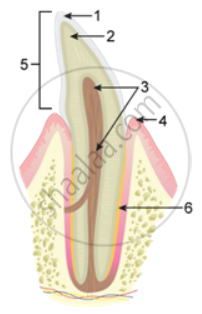
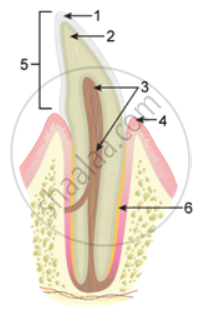
Draw a labelled diagram to show the internal structure of a mammalian tooth with two roots.


________ is the largest gland in the body.


Write four sequential steps of the procedure of the experiment "Preparing a temporary mount of a leaf peel to show stomata".


The teeth called canines are a total of four in number on the sides of ______.


Identify and name the four type of teeth shown below and give their functions


Name the three regions of the large intestine.


Food are classified into three groups on the basis of the function they perform in our body. Name the three categories, and briefly give their functions. Also give their two sources each.


Fill in the blank.

Peristalsis is caused by _____________________________.


Find the odd one out. Give reasons for your choice


The question has four options. Choose the correct answer:

Teeth present in the upper molar of human beings are


Salivary glands secrete ______.


Label the following parts in Figure and name them.

  1. The largest gland in our body.
  2. The organ where protein digestion starts.
  3. The organ that releases digestive juice into the small intestine.
  4. The organ where bile juice gets stored.

Give two reasons, why bile juice is considered to be an important secretion of liver in the process of digestion?


Share
Notifications

Englishहिंदीमराठी


      Forgot password?
Use app×