Advertisements
Advertisements
प्रश्न
What was Uncle Williams' comment on the 'tinkerers' of the world?
Advertisements
उत्तर
Uncle William is not a character in the story; however, the author gives a glimpse of him. When the author gave the watch for mending the last time, he reckoned that it was costing him more than the original cost. All the attempts so far have been futile and the verdict of the last watch maker made him remember what uncle William used to say that a good horse was a good horse until it had run away once, and that a good watch was a good watch until the repairers got a chance at it. The author perceived what his uncle had known with all his knowledge and experience. All the unsuccessful tinkers in the world are not specialists. They are the 'Jacks' of all trades and masters of none. Uncle William used to wonder what became of all those gunsmiths, shoe-makers, engineers and blacksmiths who never could be successful in their work sphere. It is important to acquire specialisation at least in one particular field, else one is left being a tinker, an apprentice, and not a specialist.
APPEARS IN
संबंधित प्रश्न
Notice these expressions in the text. Infer their meaning from the context.
-
honing our seafaring skills
-
ominous silence
-
Mayday calls
-
pinpricks in the vast ocean
-
a tousled head
|
The energy stored in coal and petroleum originally came to the earth from the sun. The bulk of the present-day supplies was laid down some 200 to 600 million years ago, when tropical conditions were widespread. Lush, swampy forests produced huge trees; warm coastal seas swarmed with microscopic forms of life. When these organisms died, much of their tissue was recycled as it is today — through scavenging and decay. But a significant amount of dead plant and animal material was covered with mud, which prevented complete decomposition. With the passage of time, layer upon layer of the fine sediment was deposited over the once-living material; the sheer weight turned the sediments to rock. Sandwiched between the layers, both coal and petroleum were produced and preserved under pressure. Coal was formed mostly of giant fern-like plants that have only small counterparts today. Coal may still be forming here and there on earth, but conditions are not right for the production of significant quantities. |
Combine related points.
|
The energy stored in coal and petroleum originally came to the earth from the sun. The bulk of the present-day supplies was laid down some 200 to 600 million years ago, when tropical conditions were widespread. Lush, swampy forests produced huge trees; warm coastal seas swarmed with microscopic forms of life. When these organisms died, much of their tissue was recycled as it is today — through scavenging and decay. But a significant amount of dead plant and animal material was covered with mud, which prevented complete decomposition. With the passage of time, layer upon layer of the fine sediment was deposited over the once-living material; the sheer weight turned the sediments to rock. Sandwiched between the layers, both coal and petroleum were produced and preserved under pressure. Coal was formed mostly of giant fern-like plants that have only small counterparts today. Coal may still be forming here and there on earth, but conditions are not right for the production of significant quantities. |
Group related points.
Notice the italicized sentence placed at the top of the article which tells us at a glance what the article is about.
Briefly explain the following statement from the text.
“You need some interaction to cause a transition.”
What do you understand of the natures of Ramanand and Azam Khan from the episode described?
Paul's final bet his family richer but cost him his life. Explain.
Discuss in pairs or groups of four.
Replacing old machines with new is better than getting them repaired.
What facet of political life does the behaviour of Ajamil illustrate?
Study the pictures below and note down the differences.
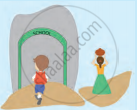
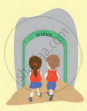
Think and write down how the following creature can be useful:
Dragon fly:
Have you heard of birds that fly from one part of the world to another in small or large flocks?
They are called Migratory birds.
Discuss and write down two reasons why they migrate and return.
The kite - Bazar in Ahmedabad, is open day and night for a week.
In the following sentence, point out the Main Clause and Subordinate Clause. Encircle the Subordinator.
Old Behrman was a painter, who lived on the ground floor.
Expand the idea inherent in the following proverb:
A Bad workman blames his tools.
Say WHY. . . . . .
Mother agreed to send Ramanujan to England.
Make a list of the channels available on your TV under the following categories: News, entertainment, sports, movies, music, etc. Which are the channels on which you can watch programs on animals, wildlife, conservation of the environment, etc.?
Make a list of functions/events/programs/activities organized in your junior college. Choose three events and plan a program schedule of your own. Prepare a script as well to show the associating role of the compere for a particular event. Make your own sequence and design a template for the same.
Explain the following statement with reference to the context.
And then, once the ring's broken, we'll get to work and show the public every day just how incompetent the Mayor is!
What question did Shalihotra ask Sushruta?
Write the following in short:
The story of the three caskets.
Complete the following sentence with reference to the passage:
He realised that making the body suffer was not ____________.
Write a review of your favorite book. Use the following points:
- Title of the book
- Author/Authors
- The central idea or story
- The important characters
- Some special features of the book
- Why it is your favourite book.
These two passages are examples of a short introduction to works of art - a short review. They cover the following points:
- The creator
- The theme or subject matter
- Type of art
- Individual style
- Presentation techniques
- Its effect on viewers
- Message or interpretation
Compare the points with those you used for a book review and the review of a play. Present the comparison in the form of a chart.
| Book Review | Review of a play | Review of a painting |
Fill in the blank choosing the appropriate word/idiom from the lesson.
While arguing with his elders he had ______.
Pick out Archaic words from the poem and give their modern equivalents.
| Archaic Words | Modern Equivalents | |
| (a) | ||
| (b) | ||
| (c) | ||
| (d) | ||
| (e) |
Name the following.
Captain of the Indian Team.
Read the highlighted words. They are adverbs.
- I was pulling hard.
- They ran away.
- Later, I was taken to the city.
- I went very carefully.
- They were greatly pleased.
Rewrite the following line in your own words.
.......... ‘till off they flash
Singing sweetly their delight.’
What methods did Anshuman's parents use to warn Anshuman about his bad habits?
Find a word that has a similar meaning.
Sorry
Have you ever seen or used a computer?
What is a website?
Read the following line from the poem and answer the question that follow.
So let the way wind up the hill or down, O'er rough or smooth, the journey will be joy: Still seeking what I sought when but a boy, New friendship, high adventure, and a crown,
- How is the way of life?
- How should be the journey of life?
- What did the poet seek as a boy?
Look at the following expressions from the text. With the help of your teacher rewrite them in standard English. One has been done for you.
| 1. ‘Musta got away – whatt’d he like? | Must got away - what was he like?’ |
| 2. ‘Looky here, Joe | |
| 3. ‘No sign o’ nothing’ | |
| 4. ‘Back t’ the lines ye goodaam | |
| 5. ‘What was the idea of all them cops tarryhootin’ round the house last night. |
Read the following line from the poem and answer the question given below.
| And so it were wisest to keep our feet From wandering into Complaining Street; |
- What is the wisest thing that the poet suggests?
- What does the phrase ‘to keep our feet from wandering’ refer to?
Read the story again and write how these character reacted in these situation:
Zigzag hardly never sleeps.
Somu………………………
Dr.Krishnan……………………….
Hamid was like one with wings on his feet. This means ______
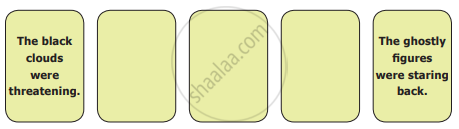
Two scary events from this section are listed here. Write the events that take place in between in the correct order.
What kind of joy is unfurled during the festival of sacrifice?
Write down the word that alliterate in the poetic line below
Festival of Flowers.
Tackling the Issues
Ask the class to discuss solutions to an issue that plagues contemporary society at large or just your community—for example, homelessness, violence, environmental degradation, hunger.
Half the class should mention idealistic solutions to the chosen issue; the other half should mention only realistic approaches to solving the problem.
See if, in listening to both sides, someone can come up with a proposal that is both realistic and unconventional—an idea that hasn't been tried yet.
He always had lunch with his family.
Rearrange the following jumbled sentences in the correct order.
- Payal’s house was a home for abandoned animals.
- It was a small ball of brown and grey.
- She found an owlet in one corner.
- Payal’s mother picked her up gently.
- Payal’s mother opened the carton.
- One day they got a carton.
Brain of a robot is the______.
What was the lesson learnt by Uthaman?
The official's family visited the rehabilitation centre for ______ years.
Read the advertisement and answer the question given below.

What is free, for LED TV?
Kani and Teddy were in the garden at _____.
Do you think you treat everyone equally? Justify with an example.
Fill in the blank with rhyming word.
larder- ______
Write the rhyming word.
save- ______
Recite the poem with correct intonation.
What would you like to learn in school? why?
In memory of his mother, he carved ______ statue.
What was the truth finally learned by Chris?
The garden Alice saw was
Who was Hiawatha?
What did the carpenter buy?
Being a bachelor, the stranger had no patience with children.
