Advertisements
Advertisements
प्रश्न
The function
पर्याय
injective but not surjective
surjective but not injective
injective as well as surjective
neither injective nor surjective
Advertisements
उत्तर
Injectivity:
Let x and y be any two elements in the domain (R), such that f(x) = f(y). Then,
\[ \Rightarrow x = \pm y\]
Surjectivity:
\[\text{and} f\left( 1 \right) = 1^2 = 1, \]
\[f\left( - 1 \right) = f\left( 1 \right)\]
So, the answer is (d) .
APPEARS IN
संबंधित प्रश्न
Check the injectivity and surjectivity of the following function:
f : R → R given by f(x) = x2
Check the injectivity and surjectivity of the following function:
f : N → N given by f(x) = x3
In the following case, state whether the function is one-one, onto or bijective. Justify your answer.
f : R → R defined by f(x) = 1 + x2
Let A and B be sets. Show that f : A × B → B × A such that f(a, b) = (b, a) is bijective function.
Let f : N → N be defined by f(n) = `{((n+1)/2", if n is odd"),(n/2", if n is even"):}` for all n ∈ N.
State whether the function f is bijective. Justify your answer.
Show that the function f : R → {x ∈ R : –1 < x < 1} defined by f(x) = `x/(1 + |x|)`, x ∈ R is one-one and onto function.
Find the number of all onto functions from the set {1, 2, 3, ..., n} to itself.
Classify the following function as injection, surjection or bijection :
f : R → R, defined by f(x) = x3 + 1
Classify the following function as injection, surjection or bijection :
f : R → R, defined by f(x) = x3 − x
If f : R → R be the function defined by f(x) = 4x3 + 7, show that f is a bijection.
Give examples of two one-one functions f1 and f2 from R to R, such that f1 + f2 : R → R. defined by (f1 + f2) (x) = f1 (x) + f2 (x) is not one-one.
Given A = {2, 3, 4}, B = {2, 5, 6, 7}. Construct an example of each of the following:
(i) an injective map from A to B
(ii) a mapping from A to B which is not injective
(iii) a mapping from A to B.
Find gof and fog when f : R → R and g : R → R is defined by f(x) = 2x + x2 and g(x) = x3
Find gof and fog when f : R → R and g : R → R is defined by f(x) = 8x3 and g(x) = x1/3.
Let A = {1, 2, 3, 4}; B = {3, 5, 7, 9}; C = {7, 23, 47, 79} and f : A → B, g : B → C be defined as f(x) = 2x + 1 and g(x) = x2 − 2. Express (gof)−1 and f−1 og−1 as the sets of ordered pairs and verify that (gof)−1 = f−1 og−1.
Show that the function f : Q → Q, defined by f(x) = 3x + 5, is invertible. Also, find f−1
If f : Q → Q, g : Q → Q are two functions defined by f(x) = 2 x and g(x) = x + 2, show that f and g are bijective maps. Verify that (gof)−1 = f−1 og −1.
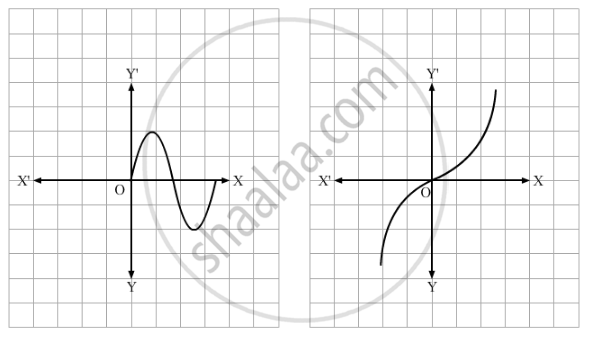
Which of the following graphs represents a one-one function?
If f : C → C is defined by f(x) = x2, write f−1 (−4). Here, C denotes the set of all complex numbers.
If f : R → R, g : R → are given by f(x) = (x + 1)2 and g(x) = x2 + 1, then write the value of fog (−3).
Let \[f : \left[ - \frac{\pi}{2}, \frac{\pi}{2} \right] \to\] A be defined by f(x) = sin x. If f is a bijection, write set A.
Let `f : R - {- 3/5}` → R be a function defined as `f (x) = (2x)/(5x +3).`
f-1 : Range of f → `R -{-3/5}`.
Write the domain of the real function
`f (x) = 1/(sqrt([x] - x)`.
The function f : R → R defined by
`f (x) = 2^x + 2^(|x|)` is
Let f be an injective map with domain {x, y, z} and range {1, 2, 3}, such that exactly one of the following statements is correct and the remaining are false.
\[f\left( x \right) = 1, f\left( y \right) \neq 1, f\left( z \right) \neq 2 .\]
The value of
\[f^{- 1} \left( 1 \right)\] is
If a function\[f : [2, \infty )\text{ to B defined by f}\left( x \right) = x^2 - 4x + 5\] is a bijection, then B =
A function f from the set of natural numbers to the set of integers defined by
\[f\left( n \right)\begin{cases}\frac{n - 1}{2}, & \text{when n is odd} \\ - \frac{n}{2}, & \text{when n is even}\end{cases}\]
\[f : Z \to Z\] be given by
` f (x) = {(x/2, ", if x is even" ) ,(0 , ", if x is odd "):}`
Then, f is
Show that the function f: R → R defined by f(x) = `x/(x^2 + 1)`, ∀ ∈ + R , is neither one-one nor onto
Let X = {1, 2, 3}and Y = {4, 5}. Find whether the following subset of X ×Y are function from X to Y or not
f = {(1, 4), (1, 5), (2, 4), (3, 5)}
Let f: R → R be given by f(x) = tan x. Then f–1(1) is ______.
Which of the following functions from Z into Z is bijective?
Let R be a relation on the set L of lines defined by l1 R l2 if l1 is perpendicular to l2, then relation R is ____________.
The solution set of the inequation log1/3(x2 + x + 1) + 1 > 0 is ______.
Difference between the greatest and least value of f(x) = `(1 + (cos^-1x)/π)^2 - (1 + (sin^-1x)/π)^2` is ______.
Let f(x) be a polynomial of degree 3 such that f(k) = `-2/k` for k = 2, 3, 4, 5. Then the value of 52 – 10f(10) is equal to ______.
For \(f:\mathbb{R}\to\mathbb{R}\) defined by \(f(x)=1+x^2\), which statement is correct?
Which real-life situation resembles a one-one idea when no roll number is repeated?
Which condition represents an into function?
