Advertisements
Advertisements
प्रश्न
Write the domain of the real function
`f (x) = 1/(sqrt([x] - x)`.
Advertisements
उत्तर
\[Case-1: Whenx > 0\]
\[\left| x \right| = x\]
\[ \Rightarrow \frac{1}{\sqrt{\left| x \right| - x}} = \frac{1}{\sqrt{x - x}} = \frac{1}{0} = \infty \]
\[{Case-2: \text{Whenx} < 0\]
\[\left| x \right| = - x\]
\[ \Rightarrow \frac{1}{\sqrt{\left| x \right| - x}} = \frac{1}{\sqrt{- x - x}} = \frac{1}{\sqrt{- 2x}} \left( \text{exists because when} x<0, -2x>0 \right)\]
\[\ \text{Rightarrowf}\left ( x \right) \text {is defined whenx}< 0\]
\[\text{So, domain}=\left( - \infty , 0 \right)\]
\[\]
APPEARS IN
संबंधित प्रश्न
Check the injectivity and surjectivity of the following function:
f : N → N given by f(x) = x2
Give an example of a function which is neither one-one nor onto ?
Classify the following function as injection, surjection or bijection : f : N → N given by f(x) = x2
Classify the following function as injection, surjection or bijection :
f : Z → Z, defined by f(x) = x2 + x
Classify the following function as injection, surjection or bijection :
f : R → R, defined by f(x) = sinx
Let A = [-1, 1]. Then, discuss whether the following function from A to itself is one-one, onto or bijective : `f (x) = x/2`
If A = {1, 2, 3}, show that a one-one function f : A → A must be onto.
Show that if f1 and f2 are one-one maps from R to R, then the product f1 × f2 : R → R defined by (f1 × f2) (x) = f1 (x) f2 (x) need not be one - one.
Let R+ be the set of all non-negative real numbers. If f : R+ → R+ and g : R+ → R+ are defined as `f(x)=x^2` and `g(x)=+sqrtx` , find fog and gof. Are they equal functions ?
Let f : R → R and g : R → R be defined by f(x) = x2 and g(x) = x + 1. Show that fog ≠ gof.
Find fog and gof if : f (x) = ex g(x) = loge x .
Find fog and gof if : f (x) = x+1, g (x) = sin x .
Let f(x) = x2 + x + 1 and g(x) = sin x. Show that fog ≠ gof.
If f(x) = 2x + 5 and g(x) = x2 + 1 be two real functions, then describe each of the following functions:
(1) fog
(2) gof
(3) fof
(4) f2
Also, show that fof ≠ f2
Find f −1 if it exists : f : A → B, where A = {0, −1, −3, 2}; B = {−9, −3, 0, 6} and f(x) = 3 x.
Consider f : {1, 2, 3} → {a, b, c} and g : {a, b, c} → {apple, ball, cat} defined as f (1) = a, f (2) = b, f (3) = c, g (a) = apple, g (b) = ball and g (c) = cat. Show that f, g and gof are invertible. Find f−1, g−1 and gof−1and show that (gof)−1 = f −1o g−1
A function f : R → R is defined as f(x) = x3 + 4. Is it a bijection or not? In case it is a bijection, find f−1 (3).
Which of the following graphs represents a one-one function?
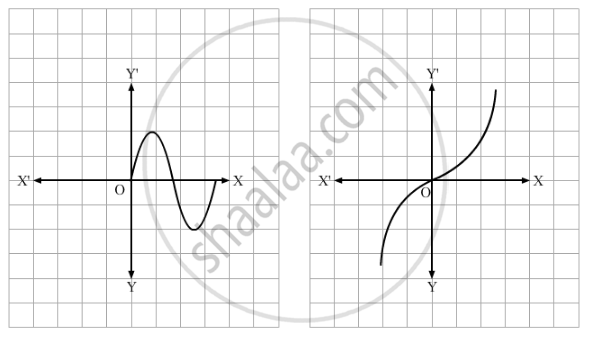
Write the total number of one-one functions from set A = {1, 2, 3, 4} to set B = {a, b, c}.
If f : R → R is defined by f(x) = x2, write f−1 (25)
If f : R → R is defined by f(x) = 10 x − 7, then write f−1 (x).
If f : R → R be defined by f(x) = (3 − x3)1/3, then find fof (x).
Let A = {a, b, c, d} and f : A → A be given by f = {( a,b ),( b , d ),( c , a ) , ( d , c )} write `f^-1`. [NCERT EXEMPLAR]
The function f : [-1/2, 1/2, 1/2] → [-π /2,π/2], defined by f (x) = `sin^-1` (3x - `4x^3`), is
Let
\[f : R \to R\] be a function defined by
The function
If \[f\left( x \right) = \sin^2 x\] and the composite function \[g\left( f\left( x \right) \right) = \left| \sin x \right|\] then g(x) is equal to
If \[f : R \to R\] is given by \[f\left( x \right) = x^3 + 3, \text{then} f^{- 1} \left( x \right)\] is equal to
Mark the correct alternative in the following question:
If the set A contains 5 elements and the set B contains 6 elements, then the number of one-one and onto mappings from A to B is
Let A be a finite set. Then, each injective function from A into itself is not surjective.
Let X = {1, 2, 3}and Y = {4, 5}. Find whether the following subset of X ×Y are function from X to Y or not
f = {(1, 4), (1, 5), (2, 4), (3, 5)}
Using the definition, prove that the function f: A→ B is invertible if and only if f is both one-one and onto
Let f: R→R be defined as f(x) = 2x – 1 and g: R – {1}→R be defined as g(x) = `(x - 1/2)/(x - 1)`. Then the composition function f (g(x)) is ______.
Let f(x) be a polynomial function of degree 6 such that `d/dx (f(x))` = (x – 1)3 (x – 3)2, then
Assertion (A): f(x) has a minimum at x = 1.
Reason (R): When `d/dx (f(x)) < 0, ∀ x ∈ (a - h, a)` and `d/dx (f(x)) > 0, ∀ x ∈ (a, a + h)`; where 'h' is an infinitesimally small positive quantity, then f(x) has a minimum at x = a, provided f(x) is continuous at x = a.
Let \(X=\{-1,2,5,8,11\}\), \(Y=\{4,6,8\}\), and suppose different elements \(2,5,8\) of \(X\) have the same image \(4\). What type of function is it with respect to the one-one property?
Many students choosing the same favourite subject resembles which type of function?
Which condition represents a many-one function?
