Advertisements
Advertisements
प्रश्न
पर्याय
x
1
f(x)
g(x)
Advertisements
उत्तर
(b) 1 \[\text{When}, - 1 < x < 0\]
\[\text{Then}, g(x) = 1 + x - \left[ x \right]\]
\[ = 1 + x - \left( - 1 \right) = 2 + x\]
\[ \therefore f\left( g(x) \right) = 1 \]
\[\text{When}, x = 0\]
\[\text{Then}, g(x) = 1 + x - \left[ x \right]\]
\[ = 1 + x - 0 = 1 + x\]
\[ \therefore f\left( g(x) \right) = 1\]
\[\text{When}, x > 1\]
\[\text{Then}, g(x) = 1 + x - \left[ x \right]\]
\[ = 1 + x - 1 = x\]
\[ \therefore f\left( g(x) \right) = 1\]
Therefore, for each interval f(g(x)) =1
APPEARS IN
संबंधित प्रश्न
Check the injectivity and surjectivity of the following function:
f : N → N given by f(x) = x3
Let f : N → N be defined by f(n) = `{((n+1)/2", if n is odd"),(n/2", if n is even"):}` for all n ∈ N.
State whether the function f is bijective. Justify your answer.
Show that the function f : R → R given by f(x) = x3 is injective.
Give an example of a function which is not one-one but onto ?
Classify the following function as injection, surjection or bijection :
f : R → R, defined by f(x) = 1 + x2
Let A = [-1, 1]. Then, discuss whether the following function from A to itself is one-one, onto or bijective : g(x) = |x|
Set of ordered pair of a function? If so, examine whether the mapping is injective or surjective :{(x, y) : x is a person, y is the mother of x}
Find gof and fog when f : R → R and g : R → R is defined by f(x) = 2x + 3 and g(x) = x2 + 5 .
Let R+ be the set of all non-negative real numbers. If f : R+ → R+ and g : R+ → R+ are defined as `f(x)=x^2` and `g(x)=+sqrtx` , find fog and gof. Are they equal functions ?
Find fog and gof if : f (x) = ex g(x) = loge x .
Find fog and gof if : f (x) = x2 g(x) = cos x .
State with reason whether the following functions have inverse :
g : {5, 6, 7, 8} → {1, 2, 3, 4} with g = {(5, 4), (6, 3), (7, 4), (8, 2)}
State with reason whether the following functions have inverse:
h : {2, 3, 4, 5} → {7, 9, 11, 13} with h = {(2, 7), (3, 9), (4, 11), (5, 13)}
Show that the function f : Q → Q, defined by f(x) = 3x + 5, is invertible. Also, find f−1
If f : Q → Q, g : Q → Q are two functions defined by f(x) = 2 x and g(x) = x + 2, show that f and g are bijective maps. Verify that (gof)−1 = f−1 og −1.
Let A and B be two sets, each with a finite number of elements. Assume that there is an injective map from A to B and that there is an injective map from B to A. Prove that there is a bijection from A to B.
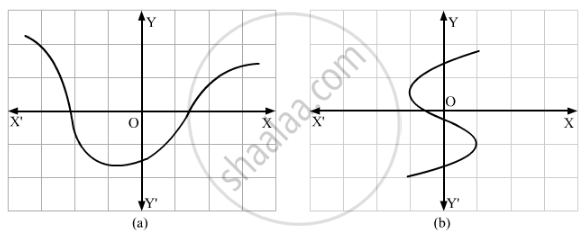
Which one of the following graphs represents a function?
If f : R → R, g : R → are given by f(x) = (x + 1)2 and g(x) = x2 + 1, then write the value of fog (−3).
Let A = {1, 2, 3}, B = {4, 5, 6, 7} and let f = {(1, 4), (2, 5), (3, 6)} be a function from A to B. State whether f is one-one or not.
The function f : [-1/2, 1/2, 1/2] → [-π /2,π/2], defined by f (x) = `sin^-1` (3x - `4x^3`), is
The function \[f : R \to R\] defined by
\[f\left( x \right) = 6^x + 6^{|x|}\] is
If \[g \left( f \left( x \right) \right) = \left| \sin x \right| \text{and} f \left( g \left( x \right) \right) = \left( \sin \sqrt{x} \right)^2 , \text{then}\]
Let R be the set of real numbers and f: R → R be the function defined by f(x) = 4x + 5. Show that f is invertible and find f–1.
Set A has 3 elements and the set B has 4 elements. Then the number of injective mappings that can be defined from A to B is ______.
Let A = R – {3}, B = R – {1}. Let f: A → B be defined by f(x) = `(x - 2)/(x - 3)` ∀ x ∈ A . Then show that f is bijective.
Let f: R → R be defined by f(x) = `1/x` ∀ x ∈ R. Then f is ______.
Let g(x) = x2 – 4x – 5, then ____________.
Let f : R → R, g : R → R be two functions such that f(x) = 2x – 3, g(x) = x3 + 5. The function (fog)-1 (x) is equal to ____________.
Range of `"f"("x") = sqrt((1 - "cos x") sqrt ((1 - "cos x")sqrt ((1 - "cos x")....infty))`
An organization conducted a bike race under 2 different categories-boys and girls. Totally there were 250 participants. Among all of them finally, three from Category 1 and two from Category 2 were selected for the final race. Ravi forms two sets B and G with these participants for his college project. Let B = {b1,b2,b3} G={g1,g2} where B represents the set of boys selected and G the set of girls who were selected for the final race.
Ravi decides to explore these sets for various types of relations and functions.
- Ravi wants to find the number of injective functions from B to G. How many numbers of injective functions are possible?
If f; R → R f(x) = 10x + 3 then f–1(x) is:
The domain of function is f(x) = `sqrt(-log_0.3(x - 1))/sqrt(x^2 + 2x + 8)` is ______.
Let f(x) be a polynomial of degree 3 such that f(k) = `-2/k` for k = 2, 3, 4, 5. Then the value of 52 – 10f(10) is equal to ______.
The function f(x) = [x], where [x] denotes the greatest integer less than or equal to x; is continuous at ______.
ASSERTION (A): The relation f : {1, 2, 3, 4} `rightarrow` {x, y, z, p} defined by f = {(1, x), (2, y), (3, z)} is a bijective function.
REASON (R): The function f : {1, 2, 3} `rightarrow` {x, y, z, p} such that f = {(1, x), (2, y), (3, z)} is one-one.
If f : R `rightarrow` R is defined by `f(x) = (2x - 7)/4`, show that f(x) is one-one and onto.

The given function f : R → R is not ‘onto’ function. Give reason.
A function is called one-one if different elements of the domain have:
A function is called into if:
Which condition represents an onto (surjective) function?
